Key Takeaways
- BESS stores electricity for later use, helping businesses manage demand peaks, solar generation and selected backup loads.
- Battery power in kW determines how much equipment it can support; capacity in kWh determines how long it can supply that power.
- Savings depend on your actual tariff, operating schedule, charging costs and battery losses.
- Backup power requires a suitable electrical design and cannot be assumed from battery capacity alone.
- A feasibility assessment should compare storage with simpler measures, including load scheduling and energy efficiency improvements.
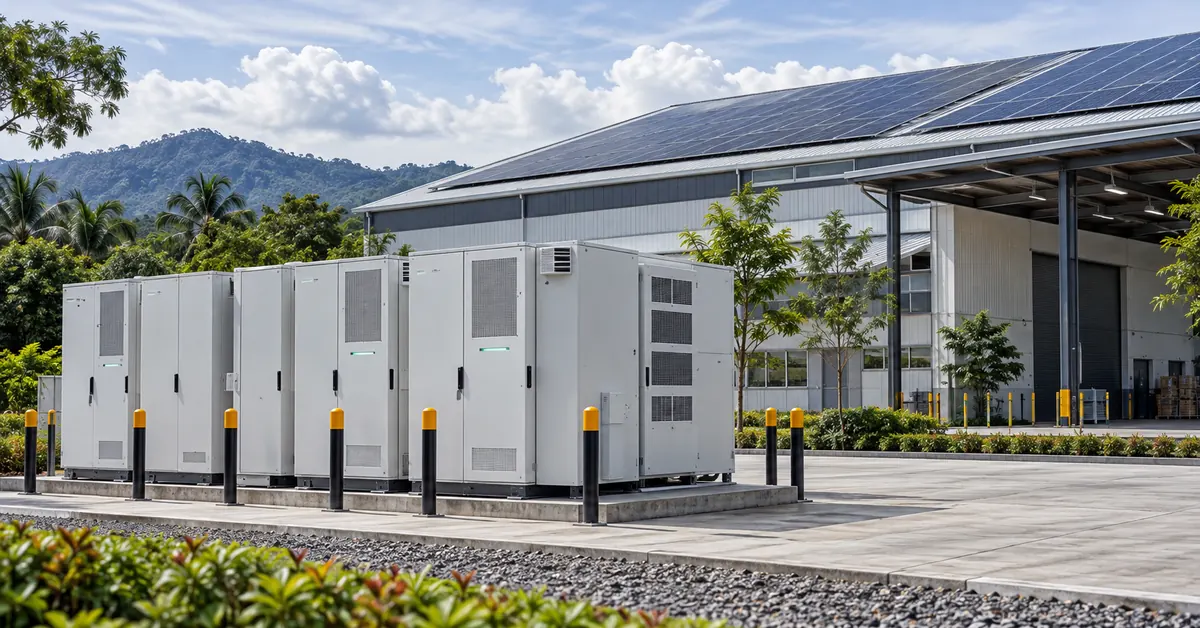
BESS stands for Battery Energy Storage System. It stores electricity and releases it when needed. For Malaysian businesses, it can reduce peak grid demand, shift solar electricity into later operating hours and support selected equipment during outages, provided the system is designed for those purposes.
When planning a solar panel system, consider how much electricity your business can use during daylight hours and whether storing surplus generation for later would add value.
However, a large electricity bill does not automatically make battery storage a good investment. A useful BESS system starts with a specific problem: a costly demand peak, unused solar generation or equipment that needs a dependable backup supply.
What Is Inside a BESS?
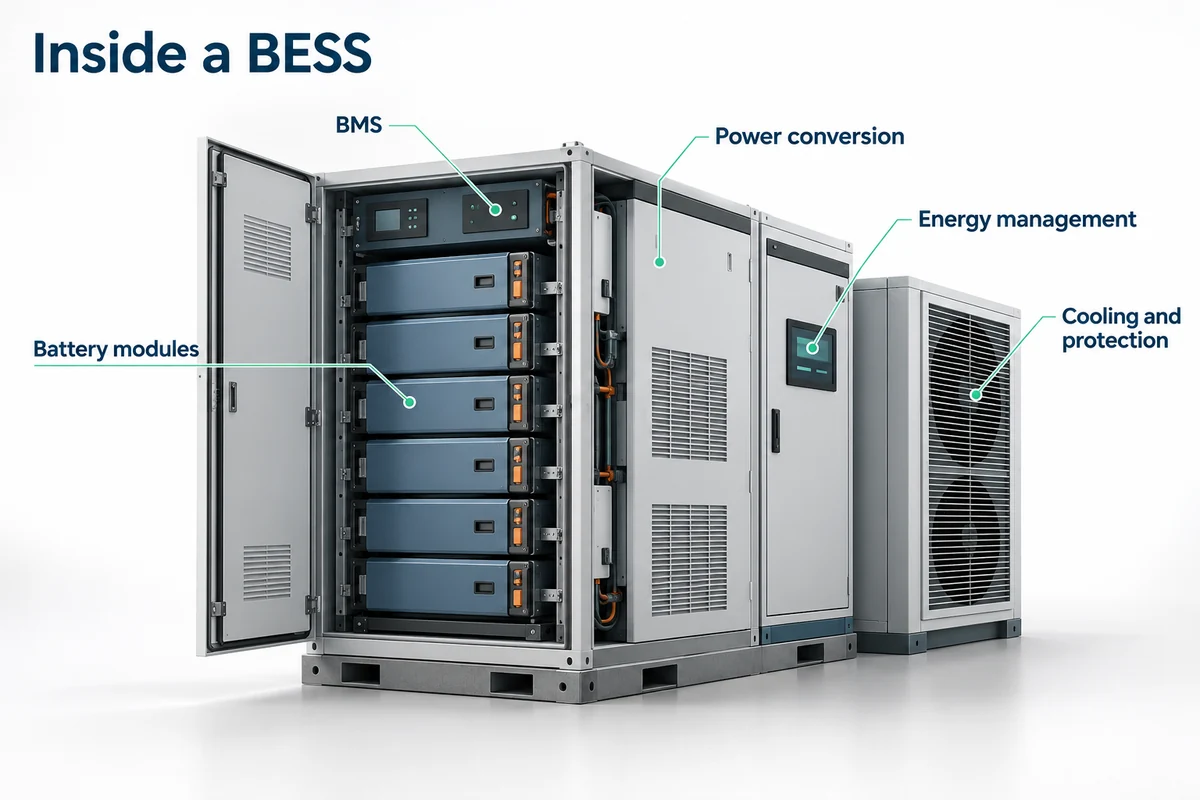
A BESS combines batteries with equipment that controls how electricity is stored, converted and delivered.
| Component | What It Does |
|---|---|
| Battery modules | Store electrical energy chemically for later use. |
| Battery Management System (BMS) | Monitors battery conditions, including cell voltage and temperature. |
| Power Conversion System (PCS) | Converts electricity between the battery’s DC supply and the site’s AC system. |
| Energy Management System (EMS) | Coordinates charging and discharging around site demand and operating priorities. |
| Cooling, protection and monitoring | Manage operating conditions, detect faults and support safe operation. |
The International Energy Agency (IEA) reported that lithium iron phosphate (LFP) accounted for 80% of new battery storage in 2023. Chemistry alone does not establish safety, warranty or site suitability.
How Does BESS Work With Solar and the Grid?
Solar panels generate electricity during daylight hours. When generation exceeds immediate site consumption, a compatible battery system can store some of that surplus and discharge it later.
A warehouse with midday solar surplus and an evening dispatch shift may benefit. A factory already consuming almost all its solar generation during the day has less surplus to store.
This is why industrial solar panel installation and battery sizing should be assessed together. Roof capacity, production schedules and electricity consumption need to be matched before deciding how much storage to add.
A BESS can also charge from the grid where the equipment, connection arrangements and applicable rules allow. Whether that saves money depends on charging prices, discharge timing and losses. Storage shifts electricity; it does not generate additional energy.
When Does Battery Storage Make Sense for a Malaysian Business?
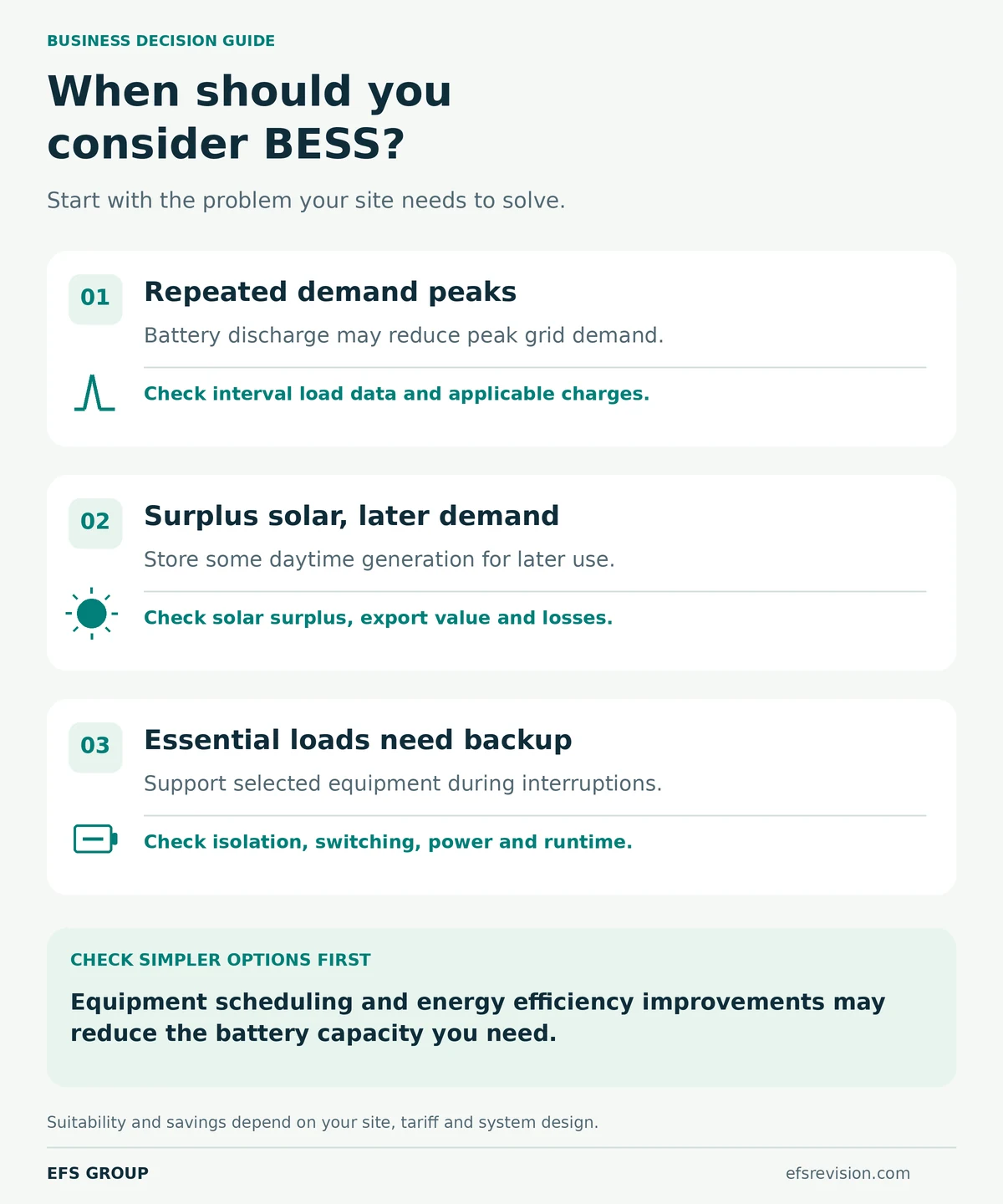
| Business Situation | Potential Value | What Must Be Checked |
|---|---|---|
| Repeated peaks in grid demand | Peak shaving | Timing, duration and applicable demand-based charges. |
| Solar surplus followed by later electricity demand | Higher solar self-consumption | Actual surplus, export arrangements and storage losses. |
| Expensive interruptions to essential equipment | Selected-load backup | Required power, runtime and safe isolation from the grid. |
| New EV chargers or production equipment | Demand management | Added load, charging schedules and existing supply limits. |
Reducing Maximum Demand
Peak shaving means discharging a battery to reduce the amount of power a site draws from the grid during a demand peak.
TNB defines monthly Maximum Demand using the largest electricity consumption recorded over a consecutive 30-minute period, expressed as an equivalent kW demand. The relevant charging period and tariff conditions must also be checked for the account.
For example, if a factory would draw 500 kW throughout a relevant half-hour and a battery supplies 100 kW throughout that period, grid demand falls to 400 kW. The battery delivers 50 kWh during that half-hour.
Another uncovered interval could establish the month’s billed maximum. Controls must address the full demand profile, and recharging must avoid creating a new peak.
Shifting Electricity Into More Valuable Hours
Under the revised Time-of-Use arrangements announced by Malaysia’s Energy Commission in June 2025, off-peak periods include all Saturday and Sunday, plus 10pm to 2pm on weekdays. Weekday peak hours therefore run from 2pm to 10pm.
For an eligible Peninsular Malaysia TNB account, these periods are relevant to storage scheduling. They do not establish profitability by themselves. Your tariff category, price difference, demand charges and operating pattern determine the opportunity. Sabah and Sarawak require separate utility and tariff checks.
For solar charging, compare immediate use, permitted exports and later use. Stored solar has an opportunity cost if it could otherwise offset consumption or earn export credits.
Supporting Essential Equipment During Outages
For refrigeration, communications or a controlled production shutdown, identify which loads need backup and for how long.
Not every BESS provides backup power. Malaysia’s Energy Commission guidance distinguishes normal grid-connected operation from systems designed to operate in islanded mode. Backup requires appropriate isolation, switching and controls so internal loads can remain supplied without energising the disconnected utility grid.
For sensitive equipment, confirm the acceptable interruption time. A system designed for bill management is not automatically a substitute for an uninterruptible power supply (UPS).
How Much Battery Capacity Does Your Business Need?
Start by separating power from energy.
- kW measures power: How much electricity the battery can deliver at a particular time.
- kWh measures energy: How much electricity it can deliver over a period.
If selected equipment needs 100 kW for two hours, the delivered-energy requirement is:
100 kW × 2 hours = 200 kWh
However, a battery with 200 kWh of nominal capacity may not deliver 200 kWh to your equipment. Usable capacity, conversion losses and operating reserves affect the result.
A Worked Sizing Example
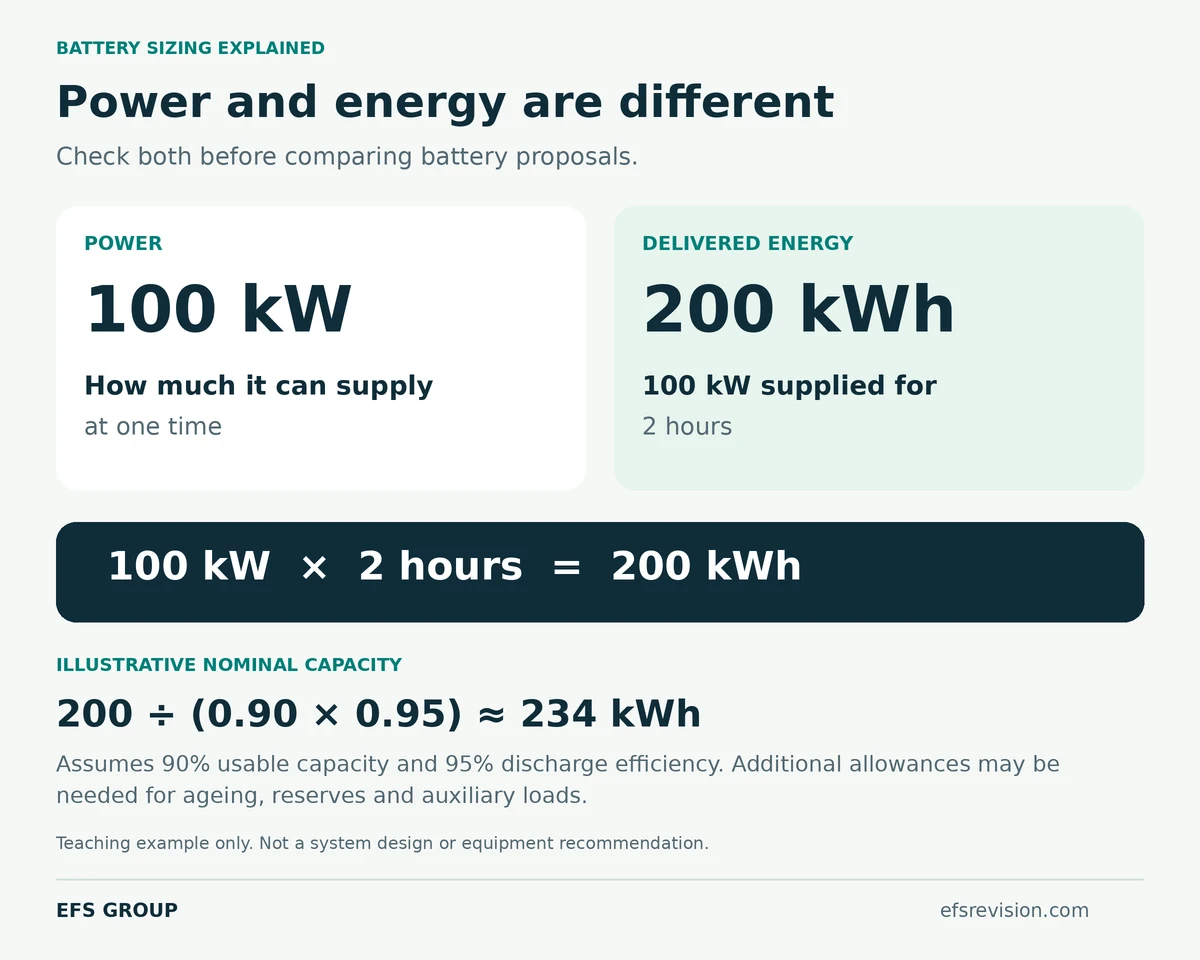
The following assumptions illustrate the calculation. They are not an EFS equipment specification or design recommendation.
| Input | Illustrative Value |
|---|---|
| Required AC output | 100 kW |
| Required duration | 2 hours |
| Energy delivered to equipment | 200 kWh |
| Usable share of nominal battery capacity | 90% |
| Discharge-path efficiency | 95% |
Indicative nominal capacity = 200 ÷ (0.90 × 0.95) = approximately 234 kWh
This is before additional allowances for ageing, reserve requirements, auxiliary consumption or operating conditions. The PCS must also support the required power and any relevant starting loads.
Ask for guaranteed usable energy at the AC delivery point, the conditions behind that guarantee and expected performance later in the warranty period.
How Do Battery Losses Affect Savings?
Round-trip efficiency measures how much usable electricity comes out compared with how much went in over a charging and discharging cycle.
The US National Laboratory of the Rockies uses 85% round-trip efficiency as a representative assumption in its 2025 commercial battery storage model. At that modelled efficiency, 100 kWh supplied for charging produces 85 kWh of useful output. Actual equipment and operating conditions can differ.
Round-trip efficiency differs from the discharge-only efficiency used above.
For grid-charged storage, a useful first check is:
Energy margin per delivered kWh = avoided electricity price − (charging price ÷ round-trip efficiency)
That margin still needs to cover battery wear, maintenance, financing and other project costs. Demand-charge reductions should be calculated separately, without counting the same benefit twice.
When Might BESS Be the Wrong First Investment?
Battery storage may be less attractive when demand is already steady, there is little surplus solar, the price difference between charging and discharging is small, or the site has a short remaining lease.
Sometimes the same problem can be reduced by staggering equipment start-up, scheduling EV charging or improving inefficient machinery. Assessing energy efficiency solutions first can reduce the load that a future battery needs to serve.
Falling battery prices also need context. The IEA reported lithium-ion battery prices declining from around US$1,400/kWh in 2010 to below US$140/kWh in 2023. These historical global battery figures are not installed BESS prices in Malaysia. Engineering, conversion equipment, protection, installation and aftercare remain part of the project cost.
What Should a BESS Feasibility Assessment Include?
Prepare electricity bills, interval load data, solar-generation records and expansion plans. Use 12 months of records, where available, to capture operating changes.
The assessment should establish:
- The main objective. Identify whether savings, solar utilisation or backup has priority.
- Power and duration. Specify the loads, peak periods and required runtime.
- Lifecycle economics. Include charging costs, losses, degradation, maintenance, financing and replacement assumptions.
- Site and safety requirements. Review location, access, cooling, protection and applicable approvals.
- Performance commitments. Confirm usable capacity, warranty limits, monitoring, response arrangements and handover tests.
Malaysia’s Energy Commission published its BESS Safety Guidelines resource on 22 May 2026. The document addresses component evaluation, electrical and thermal protection, commissioning and maintenance. Safety and service provisions should therefore be assessed alongside the headline capacity and price.
Reserving energy for outages leaves less available for routine peak shaving. Ask how competing priorities will be managed.
Is BESS the Right Next Step for Your Business?
BESS makes sense when it meets a measurable operational need and the benefits justify its lifetime cost.
At EFS Group, we assess your electricity demand, solar output and operating priorities before recommending storage. Share your bills, interval consumption data and backup requirements with our team to explore a suitable configuration.
Sources
- International Energy Agency: Batteries and Secure Energy Transitions, Executive Summary (2024).
- Tenaga Nasional Berhad: What Is Maximum Demand?.
- Energy Commission Malaysia: Electricity Tariff Restructuring Announcement, 20 June 2025.
- US Department of Energy: Solar Integration: Solar Energy and Storage Basics.
- National Laboratory of the Rockies: 2025 Annual Technology Baseline: Commercial Battery Storage.
- Energy Commission Malaysia: Guidelines on Battery Energy Storage System (BESS) Safety.