The Highlights
- Home EV charging is usually cheaper than public charging, especially for drivers who can charge regularly at home.
- Peninsular Malaysia’s TNB domestic tariff includes energy, capacity and network charges, alongside applicable adjustments and incentives.
- Public AC and DC charging prices vary by operator, location, charging speed and additional fees.
- Charging losses mean the electricity purchased can exceed the energy stored in your EV battery.
- Residential solar may reduce grid electricity purchases when EV charging coincides with solar generation.
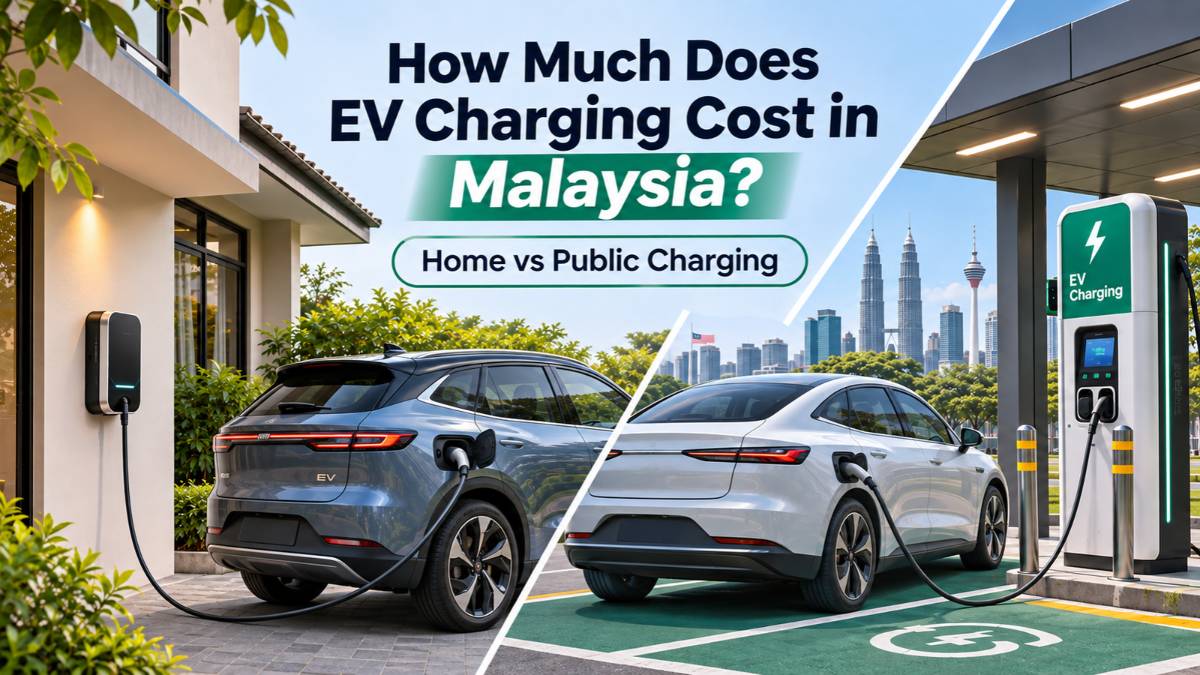
Charging an electric vehicle (EV) in Malaysia can cost less at home than at a public charging station, but the actual amount depends on your electricity tariff, battery capacity, charging efficiency and where you plug in.
For example, adding 36 kWh to an EV battery could cost approximately RM17.77 at home or RM40–RM64 at a public charger under the illustrative rates explained below.
Regardless if you’re considering your first EV or already driving one, understanding these differences can help you estimate your electricity bill, compare charging options and plan your monthly expenses.
We will even go through if Solar panels in Malaysia are worth installing if you have EV, so let’s get to it.
Home vs Public EV Charging Cost in Malaysia
The following comparison uses an illustrative EV consuming 15 kWh of battery energy per 100 km, with an assumed 90% charging efficiency. This means approximately 16.67 kWh of electricity is purchased for every 100 km driven.
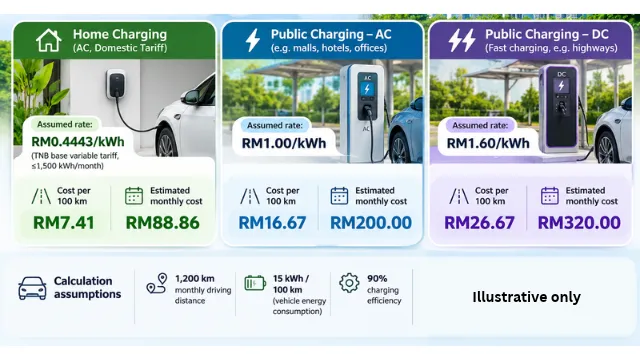
Charging method | Example rate | Cost per 100 km | Monthly cost (1,200 km) |
Home AC (TNB general tariff) | RM0.4443/kWh | RM7.41 | RM88.86 |
Public AC | RM1.00/kWh | RM16.67 | RM200.00 |
Public DC fast charging | RM1.60/kWh | RM26.67 | RM320.00 |
The figures are simplified estimates. Actual charging losses may differ between home AC and public DC charging, while public charging prices vary by station and operator.
How Are EV Charging Costs Calculated?
EV charging costs depend on how much electricity is purchased, the price per kilowatt-hour (kWh) and the energy lost during charging.
A kWh measures energy, while kW measures power or charging speed.
A 7 kW charger operating for one hour could supply approximately 7 kWh of electricity before accounting for variations in charging power.
Step 1: Calculate the Energy Your EV Needs
Suppose you drive an EV with a 60 kWh battery and want to charge it from 20% to 80%.
Energy needed = Battery capacity × Percentage charged
60 kWh × 60% = 36 kWh
This means the battery needs approximately 36 kWh of additional stored energy.
Step 2: Account for Charging Losses
Not all electricity drawn from the grid reaches the battery. Energy is lost through conversion, charging equipment, cabling and battery temperature management.
Assuming 90% charging efficiency:
Electricity required = 36 kWh ÷ 0.90 = 40 kWh
The EV receives 36 kWh, but approximately 40 kWh must be purchased.
Step 3: Calculate the Charging Cost
Charging cost = Electricity purchased × Electricity price
Using an illustrative electricity rate of RM0.4443/kWh:
40 kWh × RM0.4443 = RM17.77
This is a simplified home charging estimate, excluding additional bill adjustments. Actual charging efficiency changes with the vehicle, charger, battery temperature and charging conditions.
How Much Does It Cost to Charge an EV at Home in Malaysia?
Home EV charging costs are based on your household electricity tariff rather than a fixed EV-specific charging price.
In Peninsular Malaysia, TNB’s domestic tariff structure effective from 1 July 2025 to 31 December 2027 separates electricity charges into several components.
According to the Energy Commission’s published tariff schedule, the domestic general tariff includes:
Charge component | Published rate |
Energy charge, monthly consumption up to 1,500 kWh | 27.03 sen/kWh |
Energy charge, monthly consumption above 1,500 kWh | 37.03 sen/kWh |
Capacity charge | 4.55 sen/kWh |
Network charge | 12.85 sen/kWh |
Retail charge | RM10/month, waived at 600 kWh or less |
Important update: From September to December 2026, the government has temporarily extended protection to households using up to 800 kWh per month. Eligible households are exempt from the RM10 retail charge, Automatic Fuel Adjustment (AFA) and 8% service tax during this period.
How Much Will Home EV Charging Increase Your TNB Bill?
Suppose your household previously used 500 kWh of electricity per month. After buying an EV, you drive 1,200 km monthly at an energy consumption rate of 15 kWh per 100 km, with 90% charging efficiency.
- Monthly energy stored in the battery: 180 kWh
- Electricity purchased for charging: 200 kWh
- Illustrative additional variable electricity cost: RM88.86
- New household consumption: 700 kWh/month
However, RM88.86 is not necessarily your final bill increase.
TNB’s Energy Efficiency Incentive depends on your household’s total monthly consumption. Moving from 500 kWh to 700 kWh can reduce this incentive.
Based on the published incentive rates, the illustrative increase would be approximately RM110.36 before other applicable adjustments.
Can Charging During Off-Peak Hours Reduce Costs?
Yes, if your household qualifies for and uses TNB’s Time-of-Use (ToU) tariff.
Under the published ToU schedule, off-peak periods cover:
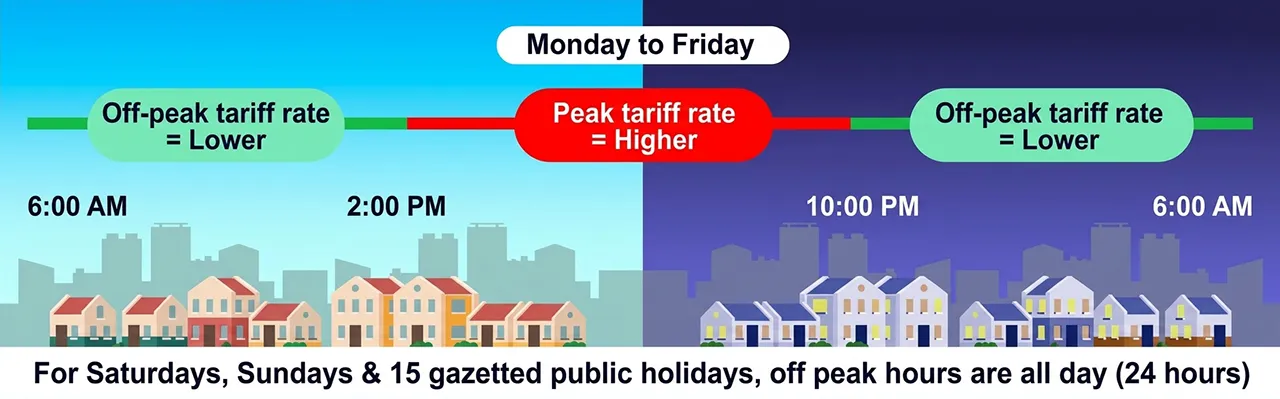
- Monday to Friday: 10 pm to 2 pm the following day
- Saturdays and Sundays: All day
- Applicable public holidays: Off-peak periods as specified by TNB
For consumption within 1,500 kWh, the published ToU energy charge is 24.43 sen/kWh during off-peak periods, compared with 28.52 sen/kWh during peak periods.
If you regularly charge your EV overnight, switching to ToU could help lower charging costs. However, the overall benefit depends on when your household uses electricity.
How Much Does Public EV Charging Cost in Malaysia?
There is no single nationwide public EV charging tariff. However, there are two main options available.
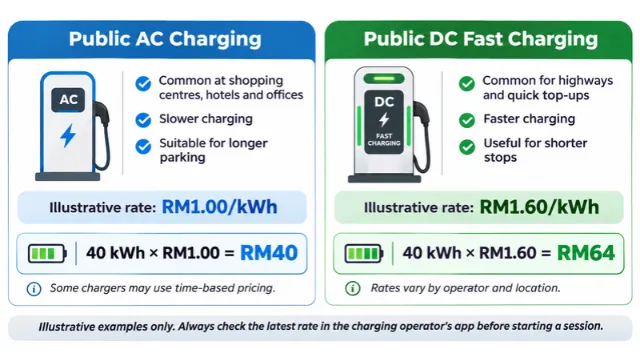
Public AC Charging
AC chargers are commonly found at shopping centres, hotels, offices and destination parking areas.
They charge more slowly than DC fast chargers and may be convenient when you intend to leave your vehicle parked for several hours.
Public DC Fast Charging
DC fast chargers deliver electricity directly to the vehicle’s battery system and are useful for highway journeys or shorter charging stops.
They can cost more per kWh, and charging speed may decrease as the battery approaches a higher state of charge.
Actual charging prices can differ substantially between sites. Gentari, for example, introduced lower DC charging prices at selected Peninsular Malaysia locations in July 2026, with reported rates starting at RM1.30/kWh at certain stations.
Always confirm the current rate in the operator’s charging app before starting a session.
Watch Out for Idle Fees and Parking Charges
The charging price is not necessarily the final amount you pay.
Additional expenses may include:
- Idle fees: Charges for remaining connected after charging has stopped.
- Parking fees: Separate charges imposed by the property or car park.
- Time-based charges: Fees determined by charging duration.
- Subscription fees: Membership costs that may apply even when discounted charging is offered.
Can Solar Panels Reduce EV Charging Costs in Malaysia?
Yes. Residential solar panels can help reduce the amount of electricity purchased from the grid when EV charging coincides with solar generation.
A solar photovoltaic (PV) system generates electricity during daylight hours. If the household has sufficient solar output available, some of that electricity can supply the EV charger.
Example: Charging an EV Using Solar Electricity
An EV charging session requires 20 kWh of electricity, and the home’s solar system supplies 12 kWh directly to the charging process.
The remaining electricity requirement would be:
20 kWh − 12 kWh = 8 kWh purchased from the grid
Using the illustrative RM0.4443/kWh variable tariff:
8 kWh × RM0.4443 = RM3.55
Without solar generation, purchasing all 20 kWh at the same rate would cost approximately RM8.89.
This represents RM5.34 in avoided electricity purchases under our example.
Under Malaysia’s Solar ATAP programme, eligible households may receive credits for surplus solar electricity exported to the grid, subject to programme rules.
For homeowners considering daytime charging, appropriately designed residential solar systems may help reduce grid dependence while supporting other household electricity needs.
How Much Does Home EV Charger Installation Cost?
Home charger installation is a separate, one-time expense and should not be confused with the electricity cost of charging the vehicle.
The final installation price depends on several factors:
- Charger type and rated power, such as a 7 kW AC wallbox.
- Distance between the distribution board and parking area.
- Existing electrical supply and available capacity.
- Cabling, protection devices and installation requirements.
- Additional electrical upgrades or modifications.
A household with suitable existing wiring and a nearby parking bay may require less installation work than one needing extensive cabling or supply upgrades.
Malaysia’s Energy Commission requires EV charging installations to follow applicable electrical safety requirements, including work performed by competent personnel.
What About EV Charging Costs for Businesses?
Businesses installing workplace EV chargers should calculate the electricity cost alongside infrastructure capacity and charging demand.
Commercial electricity accounts should not use residential TNB rates as their budgeting assumptions.
For workplaces, the main considerations include:
- Electricity consumption: The additional kWh required by employee or fleet vehicles.
- Peak demand: Whether simultaneous charging could affect electrical capacity or demand-related charges.
- Charging schedules: Opportunities to distribute charging across working hours.
- Installation costs: Chargers, electrical connections, protection equipment and associated infrastructure.
- Energy management: Whether solar generation, load management or other efficiency measures can support charging demand.
For example, five company vehicles each requiring 20 kWh of purchased electricity per working day would create an additional demand of 100 kWh daily, or approximately 2,200 kWh over 22 working days.
This additional consumption should be evaluated against the site’s applicable commercial tariff and existing load profile.
Businesses with suitable daytime operations may also consider commercial solar installations to offset part of their building and EV charging electricity requirements.
Making Home Charging Cheaper in Malaysia With Solar Panels
Home EV charging is the more affordable option for everyday driving, while public AC and DC chargers offer convenience when you’re travelling or need a quick top-up.
As more Malaysians make the switch to electric vehicles, it’s worth thinking beyond the cost of charging today.
This is where solar panels can make EV ownership even more worthwhile.
With over a decade of renewable energy experience and more than 300 MWp of solar capacity delivered, EFS Group helps Malaysian homeowners and businesses make smarter energy decisions through practical solar and energy management solutions.
Already driving an EV or planning to make the switch? Explore our energy efficiency and EV charging solutions to discover how solar energy and smarter electricity management could make your EV journey more cost-effective and sustainable.
Disclaimer: Research checked: 23 November 2026. Electricity tariffs and public charging prices should be reviewed before publication and periodically thereafter.
Sources
- Suruhanjaya Tenaga – Electricity Tariff Schedule for Peninsular Malaysia — Tariff schedule effective 1 July 2025 to 31 December 2027.
- Suruhanjaya Tenaga – Components of Incentive-Based Regulation — Base tariff and Automatic Fuel Adjustment mechanism.
- Tenaga Nasional Berhad – Time-of-Use Energy Management — Off-peak charging periods and tariff considerations.
- Gentari Go – Terms of Use — Charging conditions, idle fees and additional payment requirements.
- Setel – EV Charging Idle Fees — Operator-specific idle-fee examples.
- Suruhanjaya Tenaga – EV Charging System Guidelines — Electrical safety and installation requirements.