Key Takeaways
Start with the kWh on your TNB bill, not the amount charged in ringgit.
Estimate solar capacity in kWp, then divide by the wattage of each panel.
A larger array is not automatically better when your electricity use is concentrated at night.
Check usable roof area, shading and your property’s single-phase or three-phase supply.
Treat this as an initial sizing estimate. A professional assessment is needed before installation.
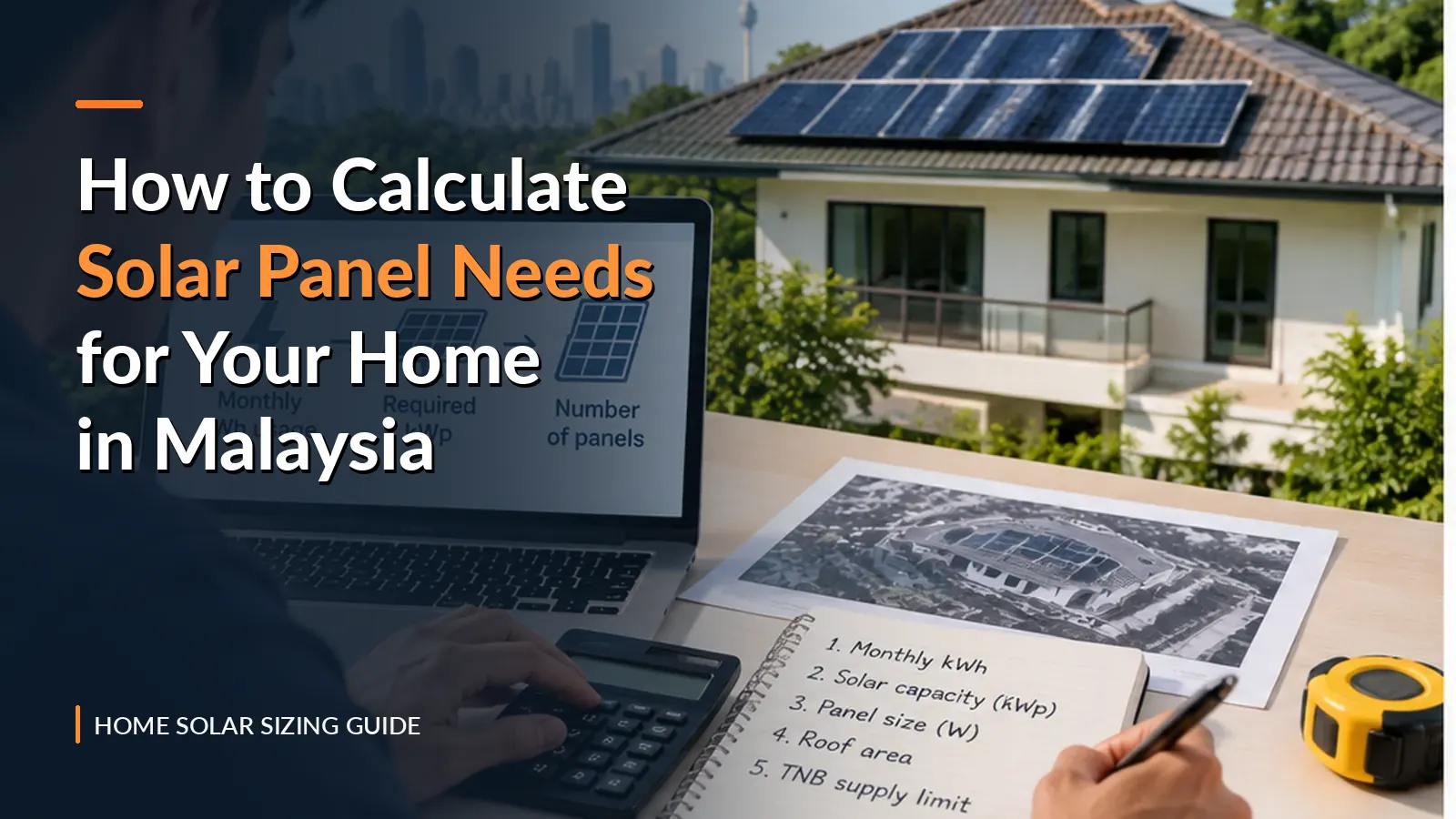
How many solar panels do you need for your home in Malaysia? Divide your average monthly electricity consumption (kWh) by an assumed monthly solar yield per kWp. Then divide the estimated capacity by each panel’s rated power. For example, 450 kWh a month could point to roughly eight 550 W panels, before checking daytime demand, roof space and electrical limits.
These are screening estimates, not installation designs or guaranteed output.
When planning a solar panel system in Malaysia, homeowners should first understand their electricity consumption rather than estimate the number of panels based on house size alone. This provides a more reliable starting point for calculating the solar capacity their household may need.
What Do kWh, kWp and kWac Mean?
These three measurements answer different questions:
| Measurement | What it tells you | Example |
|---|---|---|
| kWh | Electricity used or generated over time | 900 kWh consumed in a month |
| kWp | Combined rated DC capacity of solar panels under standard test conditions | 8.8 kWp from 16 × 550 W panels |
| kWac | Rated alternating-current output capacity of the inverter | A 7 kWac inverter |
Your TNB bill uses kWh. Solar panels are rated in kWp; their inverter converts DC electricity into AC for household use.
An 8.8 kWp array does not continuously deliver 8.8 kW. Output varies with sunlight, heat, shading and losses. Inverter sizing requires separate technical checks.
Step 1: Find Your Monthly Electricity Consumption
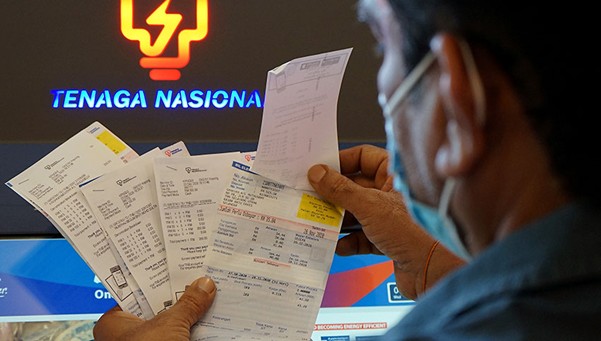
Open your latest TNB bill and locate the total electricity consumed (kWh). Do not use the RM amount as your starting point: tariffs, adjustments and other bill components can make two households with similar energy usage pay different amounts.
Average three to twelve complete months. For example:
Total over six months = 5,400 kWh
Average monthly consumption = 5,400 ÷ 6 = 900 kWh
For smart-meter households, myTNB can show more detailed usage. Consider future changes such as air conditioning or EV charging.
For context, a 2020 Seremban household study reported mean consumption of 648.31 kWh per month, with averages of 460.16 kWh for flats, 583.52 kWh for single-storey terraces, and 885.92 kWh for bungalows. These figures describe one city, not the Malaysian national average. Prioritise your own bills.
Step 2: Calculate Solar Capacity and Panel Quantity
To make the calculation reproducible, we will use two clearly labelled assumptions:
Illustrative solar yield: 105 kWh generated per month for every 1 kWp installed.
Example panel rating: 550 W per solar panel, equivalent to 0.55 kWp.
This represents 3.5 kWh of output per kWp per day across 30 days. It is not a guaranteed Malaysian yield: weather, shading and losses matter. PVGIS can help refine local estimates.
Formula 1: Estimate Required Solar Capacity
Estimated solar capacity (kWp) = Monthly consumption (kWh) ÷ 105
For a home consuming 450 kWh per month:
450 ÷ 105 = 4.29 kWp
This matches estimated total generation to monthly consumption, not direct household solar use.
Formula 2: Convert Capacity Into Panels
Number of panels = Required capacity (kWp) ÷ Panel rating (kWp)
For 550 W panels:
4.29 ÷ 0.55 = 7.8 panels
Round up to a whole number: 8 panels.
Eight 550 W panels provide 4.4 kWp DC capacity, with illustrative generation of 4.4 × 105 = 462 kWh per month.
| Monthly usage | Estimated DC capacity | 550 W panels | Indicative generation |
|---|---|---|---|
| 450 kWh | 4.29 kWp | 8 (4.4 kWp) | 462 kWh/month |
| 900 kWh | 8.57 kWp | 16 (8.8 kWp) | 924 kWh/month |
| 1,200 kWh | 11.43 kWp | 21 (11.55 kWp) | 1,213 kWh/month |
Important: Matching monthly generation to consumption is not the same as matching daytime demand.
Step 3: Compare Daytime and Nighttime Electricity Use
Solar panels usually generate most of their energy during daylight hours. Your household may use much of its electricity after sunset, especially if the property is empty during working hours.
Compare three hypothetical households. Daytime shares are illustrative, not measured averages.
| Household | Monthly use | Assumed daytime share | Daytime use | Generation-matching estimate |
|---|---|---|---|---|
| A: Working couple | 450 kWh | 25% | About 113 kWh | 8 panels |
| B: Work-from-home family | 900 kWh | 60% | 540 kWh | 16 panels |
| C: Evening-focused family | 900 kWh | 20% | 180 kWh | 16 panels |
Household A: Working Couple, Mostly Out During the Day
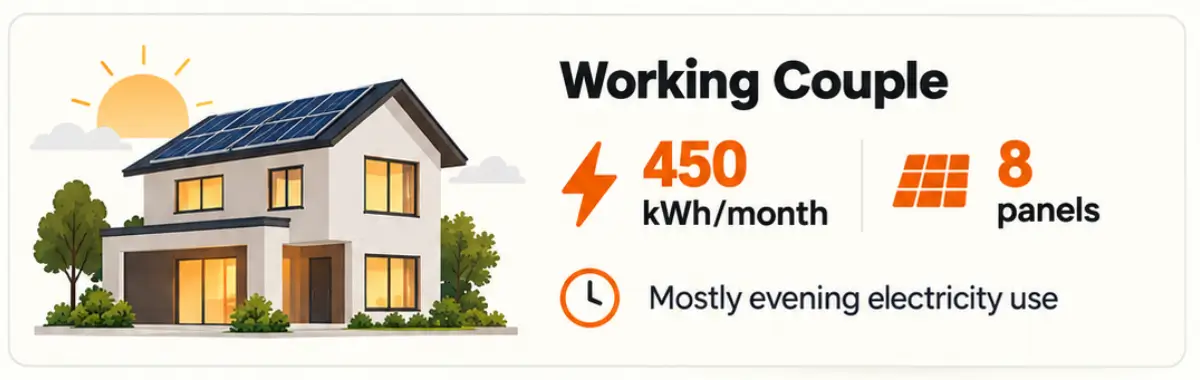
Eight panels could generate 462 kWh monthly, but this couple uses about 113 kWh in daylight. That 113 kWh is only an upper bound for direct solar use.
Household B: Work-From-Home Family
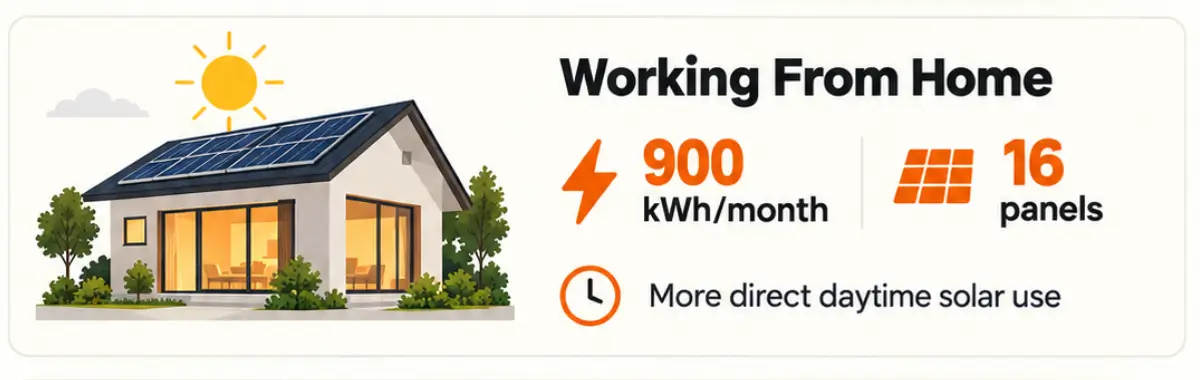
Of its 900 kWh monthly usage, 540 kWh occurs during daylight. That creates more opportunity for direct solar use, making 16 panels worth investigating.
Household C: Family With the Same Usage but Different Timing
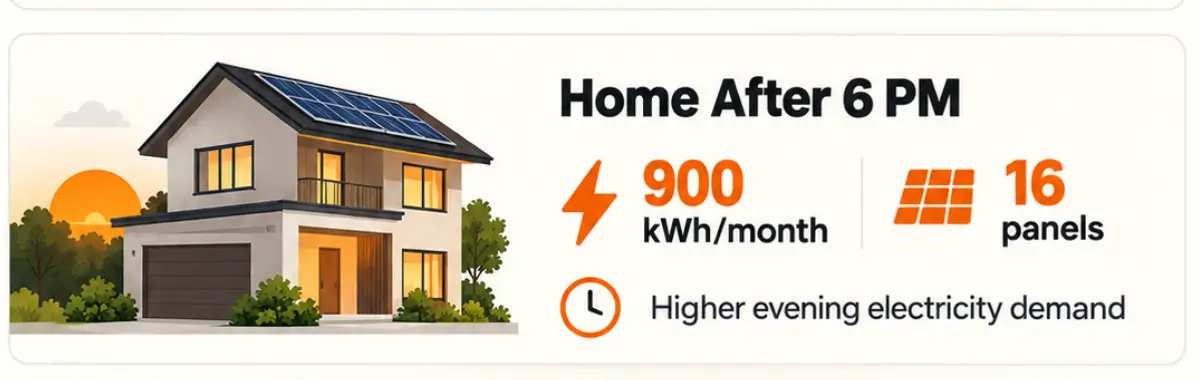
This family also uses 900 kWh, but only 180 kWh in daylight. A 16-panel array may export much more surplus electricity. Compare smaller systems too.
Equal monthly kWh does not mean equal solar self-consumption. If much of your demand is at night, battery energy storage is optional, not essential.
How Can You Estimate Daytime Appliance Usage?
Use this simple approximation:
Appliance consumption (kWh) = Average power draw (kW) × Hours used
A device averaging 1 kW for four hours consumes approximately 4 kWh. Estimate major daytime loads; variable-power appliances such as inverter air conditioners are best assessed using metered data.
Step 4: Check Your Usable Roof Area
Count usable, not total, roof area.
For an early screening exercise, allow about 3 m² per 550 W panel, including a rough layout allowance. Actual panel sizes and clearance needs vary.
| Number of 550 W panels | DC array capacity | Illustrative roof area |
|---|---|---|
| 8 | 4.4 kWp | 24 m² |
| 12 | 6.6 kWp | 36 m² |
| 16 | 8.8 kWp | 48 m² |
| 20 | 11.0 kWp | 60 m² |
If 16 panels require approximately 48 m² but only 30 m² is usable, consider fewer panels or another layout.
Obstacles include tanks, trees, skylights, shading and access clearances. Property size alone does not determine solar capacity.
Step 5: Check Your Electrical Supply and Solar ATAP Limits
Before choosing an inverter, confirm if your home receives single-phase or three-phase TNB supply. Under the current Solar ATAP framework for eligible consumers in Peninsular Malaysia, standard domestic capacity thresholds are:
| TNB supply | Solar ATAP standard AC capacity threshold |
|---|---|
| Single-phase | Up to 5 kWac |
| Three-phase | Up to 15 kWac |
Projects exceeding these thresholds require a Connection Confirmation Check (CCC) and applicable approval. These are AC/inverter capacity thresholds, not a direct count of panels. For example, an array rated at 6.6 kWp DC might be paired with a 5 kWac inverter if the equipment and engineering design permit; it is not an automatic approval.
For the full eligibility and approval details, see EFS Group’s Solar ATAP capacity requirements.
What Should a Professional Solar Site Assessment Check?
A home solar panel calculator is a helpful first filter. Before confirming the final design, the installer should examine:
Electricity profile: Past bills, daytime demand and anticipated future loads.
Solar production: Location-specific irradiation, shading, orientation and expected system losses.
Roof suitability: Usable dimensions, roof integrity, layout and safe access.
Equipment compatibility: Actual module ratings, DC-to-AC sizing and inverter selection.
Electrical compliance: Supply type and applicable TNB and Solar ATAP technical conditions.
Bring recent TNB bills, roof photographs and appliance information. EFS Group can assess solar panels for your home and turn your initial estimate into a site-specific residential solar proposal.
Conclusion: Use the Formula, Then Test the Assumptions
Monthly kWh ÷ assumed monthly yield per kWp ÷ panel rating in kWp gives you a useful first estimate of the number of panels. With our illustrative assumptions, a 450 kWh home suggests eight 550 W panels, while a 900 kWh home suggests sixteen.
Still, daytime demand, usable roof area and approved inverter capacity determine suitability. An initial estimate does not replace a professional design.