Key Takeaways
EPCC stands for Engineering, Procurement, Construction and Commissioning, covering four major stages of solar project delivery.
An EPCC contract should clearly define technical deliverables, contractor responsibilities, timelines and acceptance requirements.
Commissioning involves more than switching on solar panels. It verifies whether the installation meets applicable safety and technical requirements.
A complete solar project handover should include approved drawings, test records, equipment documentation and operating instructions.
EPCC describes how a project is delivered, not necessarily how it is financed or maintained over its lifetime.
What Does EPCC Mean in Solar Projects?
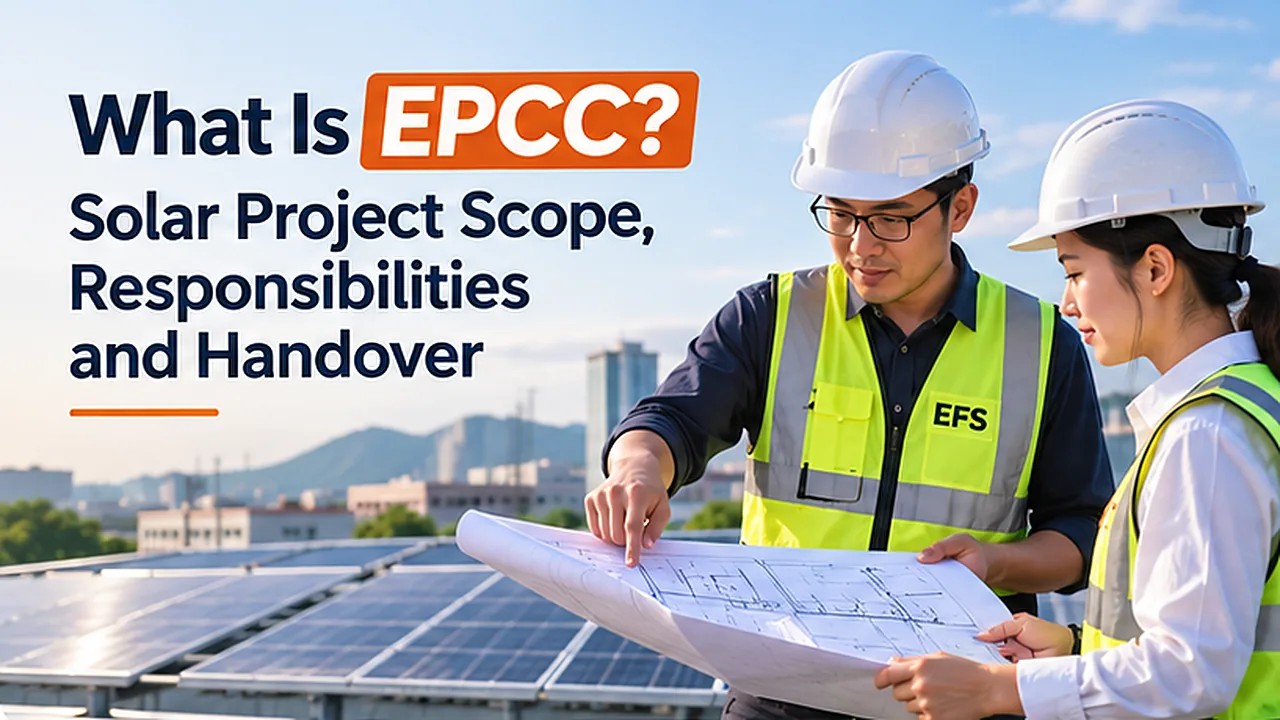
EPCC stands for Engineering, Procurement, Construction and Commissioning. In a solar project, it describes an integrated delivery approach covering system design, equipment sourcing, installation, testing and preparation for operational handover.
For Malaysian businesses considering rooftop or ground-mounted solar, understanding the EPCC meaning helps clarify what a contractor should deliver before the project is considered complete.
When evaluating an EPCC company in Malaysia, business owners should look beyond the quoted system capacity and installation price. The proposal should also identify who manages technical design, equipment compliance, construction risks, testing and outstanding work after commissioning.
This is particularly important for factories, warehouses, commercial buildings and utility-scale developments where electrical infrastructure, site access and operational requirements can be complex.
What Are the Four Stages of Solar EPCC?
Each EPCC stage has a different purpose, but the four must work together to deliver a functioning solar photovoltaic (PV) system.
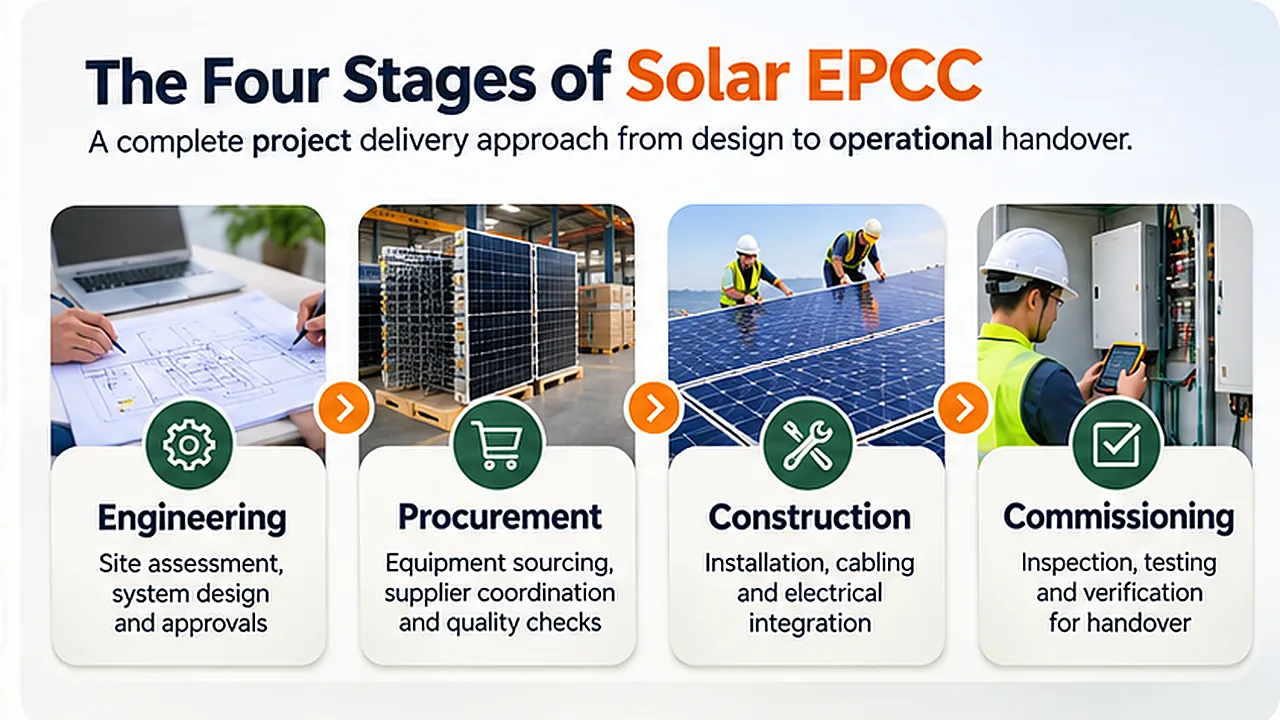
| EPCC Stage | Main Activities | Expected Deliverables |
|---|---|---|
| Engineering | Site assessment, calculations and system design | Approved designs and technical specifications |
| Procurement | Equipment sourcing, supplier coordination and quality checks | Approved equipment and supporting documentation |
| Construction | Solar panel installation, cabling and electrical integration | Installed system and construction records |
| Commissioning | Inspection, testing and operational verification | Test reports, certification and handover documents |
1. Engineering: Designing the Solar PV System
Engineering determines how the solar installation should operate before equipment is purchased or installed.
A proper assessment considers electricity consumption, site conditions, available roof or land area, structural suitability and existing electrical infrastructure.
Typical engineering activities include:
Reviewing electricity consumption and maximum demand.
Determining solar PV capacity and equipment requirements.
Preparing layout drawings and electrical single-line diagrams.
Assessing structural requirements and electrical protection.
Planning grid interconnection and identifying applicable approvals.
For example, an industrial solar panel installation must account for production schedules, machinery loads, electrical distribution arrangements and potential operational disruptions.
The engineering deliverables should give both parties a clear technical reference for the subsequent stages.
2. Procurement: Sourcing Suitable Equipment
Procurement involves more than purchasing solar panels at a competitive price.
Contractors must coordinate the supply of components that meet the approved design, technical requirements and project schedule.
These typically include solar PV modules, inverters, mounting structures, cables, protection devices and monitoring equipment.
According to the International Renewable Energy Agency (IRENA), balance-of-system costs, excluding modules and inverters, represented approximately 65% of total installed costs for utility-scale solar PV globally in 2024.
This is an international utility-scale benchmark, not a Malaysian project quotation. Nevertheless, it illustrates why solar project procurement and delivery cannot be evaluated through panel prices alone.
Business owners should confirm the equipment models, specifications, warranties and substitution procedures included in their EPCC contract.
3. Construction: Installing and Integrating the System
Construction turns the approved engineering design into a physical solar installation.
Activities generally include mounting structures, installing solar modules, connecting electrical components, routing cables and integrating the system with existing infrastructure.
For factories, careful coordination is particularly important.
An industrial solar panel installation may require controlled access to production areas, coordination with facility management and scheduled electrical shutdowns.
Meanwhile, commercial solar projects involving offices, retail properties or hospitality buildings may need construction arrangements that minimise disruption to occupants and daily operations.
The contract should specify construction supervision, safety requirements, site reinstatement and responsibility for correcting installation defects.
4. Commissioning: Verifying the Completed Solar Installation
Commissioning is the final technical verification stage before the system is accepted for operation.
It involves checking whether the installation has been completed correctly and whether relevant safety, protection and operational requirements have been satisfied.
Under IEC 62446-1, documentation, inspections and commissioning tests form part of verifying the safe installation and correct operation of grid-connected PV systems.
Commissioning activities may include:
Electrical safety and protection checks.
Verification of equipment configuration.
Inverter operation and functional testing.
Monitoring and communication system checks.
Review of applicable test results and outstanding defects.
The exact tests depend on the project and relevant standards.
After these four stages, businesses considering a complete project delivery arrangement can explore EFS Group’s EPCC services.
Who Is Responsible for What Under an EPCC Contract?
One of the biggest procurement mistakes is assuming that an integrated contractor automatically handles every project-related obligation.
EPCC responsibilities must be defined contractually.
The following matrix illustrates a typical arrangement. Actual responsibilities can differ.
| Responsibility | Typical EPCC Contractor Role | Owner’s Role |
|---|---|---|
| Technical design | Prepare and coordinate designs | Provide site information and review |
| Equipment sourcing | Procure agreed equipment | Approve contractual selections |
| Construction | Coordinate installation works | Provide site access and operational requirements |
| Approvals | Manage allocated submissions | Provide documents and authorisations |
| Commissioning | Arrange testing and records | Witness and accept agreed deliverables |
| Maintenance | Provide if separately contracted | Appoint or manage ongoing support |
For example, a contractor may coordinate utility submissions while the property owner remains responsible for providing accurate ownership information or obtaining landlord consent.
Procurement teams should request a responsibility matrix before signing.
This identifies the accountable party for each activity, approval, document and decision.
Why Do Malaysian Solar Projects Need Regulatory and Technical Checks?
Solar projects must comply with the requirements applicable to their installation type, location and electricity connection.
These requirements are not identical across self-consumption, Solar ATAP, large-scale generation and other programmes.
For example, under the Energy Commission’s June 2026 guidelines for solar PV self-consumption in Peninsular Malaysia:
Installations above 72 kWac require a connection assessment study.
For installations of 72 kWac or less, a self-assessment study may be required by the electricity utility.
Testing and commissioning must be undertaken by appropriately qualified personnel.
These are specific self-consumption requirements, not universal thresholds for every solar project or programme.
The same guidelines also refer to Form G and Form H, covering supervision, completion and testing certification.
Before proceeding, the contractor should determine which regulatory pathway applies and explain who is responsible for each submission.
This is especially relevant for large scale solar developments, where project-specific grid connection, licensing and technical requirements can involve additional coordination.
What Should Be Included in a Solar EPCC Proposal?
A quotation may look comprehensive while leaving important technical and commercial responsibilities undefined.
Before comparing contractors, ask for a proposal that addresses the following items.
Technical Scope and Equipment
The proposal should identify the DC solar panel capacity (kWp or MWp), AC inverter capacity (kWac or MWac), equipment models and expected energy generation.
These capacity measurements are not interchangeable.
For example, a proposed system might have 500 kWp of solar panels and 450 kWac of inverter capacity. The engineering design should explain why those ratings were selected.
Project Boundaries and Exclusions
Confirm whether the quoted scope includes structural assessments, existing switchboard modifications, cable routes, access equipment, utility coordination and other site-specific works.
An exclusion is not necessarily unreasonable. The problem arises when buyers discover it only after the contract has been signed.
Milestones and Acceptance
The contract should define what constitutes completion at each stage.
Useful milestones include design approval, equipment delivery, mechanical completion, electrical completion, commissioning and final handover.
Each milestone should have a corresponding deliverable or acceptance condition.
Warranties and Defect Resolution
Equipment warranties and workmanship warranties are different.
The proposal should explain which warranties apply, when they begin, who handles claims and how outstanding defects will be corrected.
It should also distinguish contractual defects from later operational maintenance.
How Is Solar Project Performance Verified?
Commissioning confirms that a system has passed the specified checks at completion. However, longer-term energy generation must be evaluated separately.
Consider a hypothetical solar project:
| Measurement | Illustrative Value |
|---|---|
| Solar panel capacity | 500 kWp |
| Assumed annual yield | 1,200 kWh/kWp |
| Modelled annual generation | 600,000 kWh |
| Example measured annual generation | 570,000 kWh |
In this example, measured generation is 5% below the modelled annual figure.
That difference alone does not establish defective work or a contractual breach.
A proper performance assessment should account for actual weather, measurement accuracy, downtime, system configuration and the method agreed in the contract.
IEC 61724-1:2021 provides an international reference for PV performance monitoring terminology, equipment and analysis.
For procurement teams, the lesson is simple: confirm the performance assumptions, monitoring method and acceptance criteria before installation, rather than debating them after handover.
What Documents Should Be Provided During Solar EPCC Handover?
A completed solar project should leave the owner with enough information to operate, maintain and assess the installation.
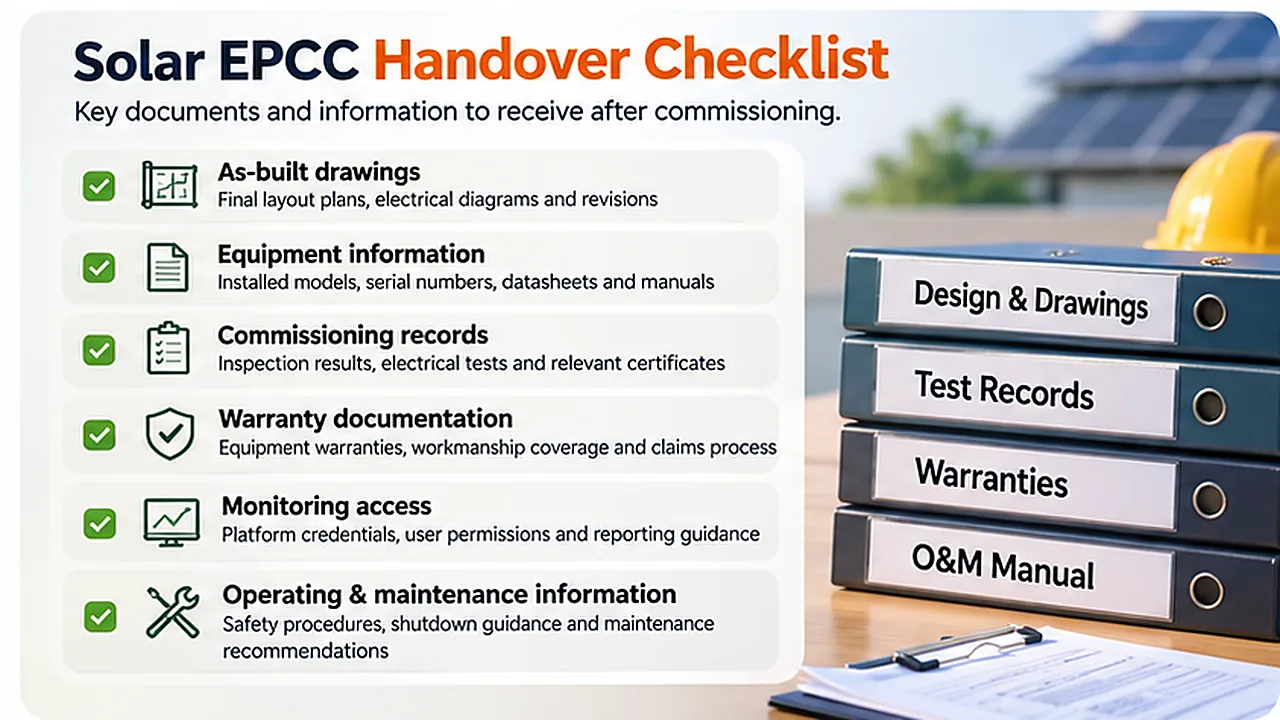
A practical handover package should include:
As-built drawings: Final layout plans, electrical diagrams and relevant approved revisions.
Equipment information: Installed models, serial numbers where applicable, datasheets and manuals.
Commissioning records: Inspection results, electrical tests and applicable certificates.
Warranty documentation: Equipment warranties, workmanship coverage and claims procedures.
Monitoring access: Platform credentials, user permissions and basic performance reporting instructions.
Operating and maintenance information: Safety procedures, shutdown guidance, maintenance recommendations and relevant contacts.
IEC 62446-1 specifically addresses customer documentation, commissioning tests and inspection for grid-connected PV installations.
The contractor and owner should also agree on how unresolved defects will be recorded and closed.
For ongoing system performance, solar operation and maintenance can cover monitoring, preventive inspections, fault diagnosis and corrective work after the EPCC phase.
What Is the Difference Between EPC and EPCC?
EPC stands for Engineering, Procurement and Construction. EPCC explicitly adds Commissioning.
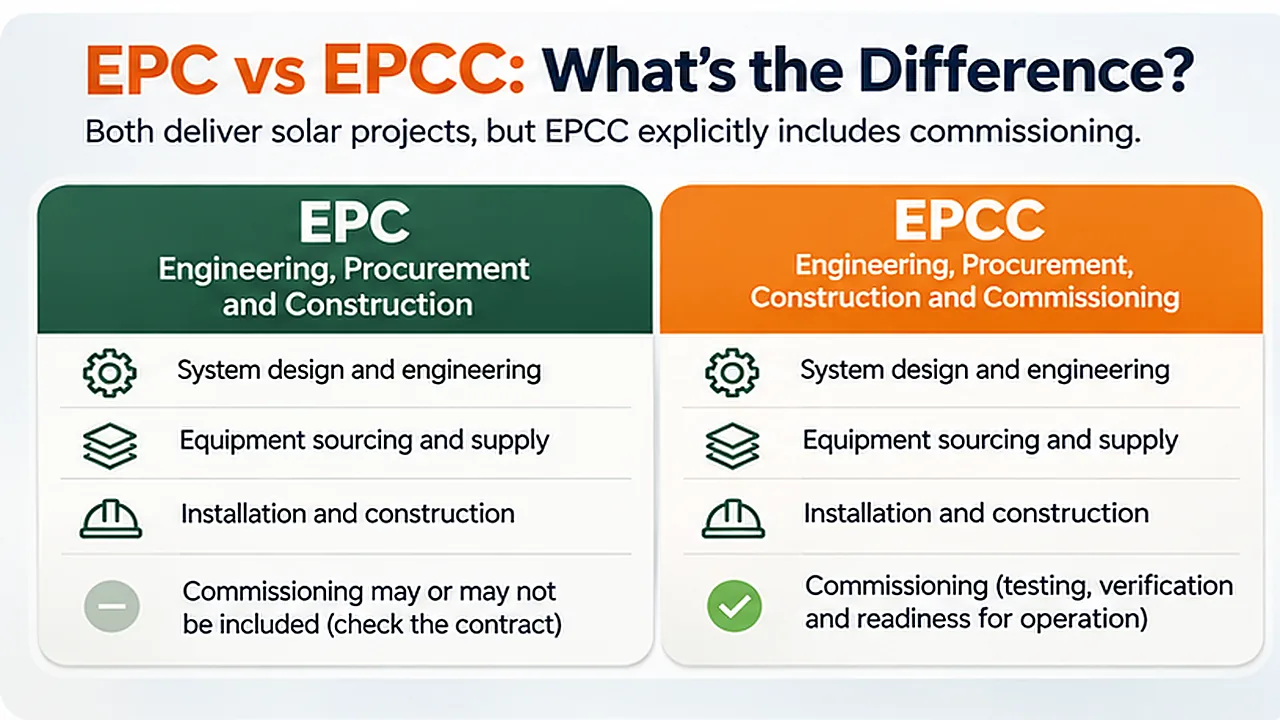
However, the distinction is not always as large as it appears.
Many EPC contracts already include testing and commissioning within their agreed scope. Therefore, the inclusion of an additional letter does not automatically mean an EPCC contract provides greater protection.
What matters is the actual contractual obligation.
| Contract Term | Main Meaning | Key Consideration |
|---|---|---|
| EPC | Engineering, Procurement and Construction | Check whether commissioning is included |
| EPCC | Engineering, Procurement, Construction and Commissioning | Define testing, acceptance and handover |
| Installation-only | Construction or installation services | Design and equipment supply may be separate |
Similarly, EPCC is not a financing model.
Whether the owner purchases the system, uses financing or enters a power purchase agreement is a separate commercial decision. Those arrangements can influence contractual responsibilities but do not change what the EPCC acronym stands for.
There is also no universal Malaysian credential called an “EPCC certification” that, by itself, establishes a contractor’s eligibility for every solar project. Relevant registrations, competent personnel and technical qualifications must be checked according to the work involved.
How Do You Choose the Right Solar EPCC Contractor?
When shortlisting contractors, focus on documented capabilities and accountability rather than a list of promised services.
Ask these seven questions:
Who takes responsibility for the complete engineering design?
Which equipment models and technical specifications are included?
Who coordinates regulatory submissions and utility approvals?
What site preparation or electrical works are excluded?
Which tests and documents are required before acceptance?
Who resolves defects and handles warranty claims?
Is maintenance included, optional or contracted separately?
You should also review the contractor’s experience with projects similar to your own.
For example, factory rooftop projects, commercial property installations and utility-scale developments have different operating conditions and technical challenges.
Reviewing completed solar projects can help buyers assess whether a contractor has relevant project experience.
Conclusion: A Good EPCC Contract Defines More Than Installation
Understanding what EPCC means helps businesses make better solar procurement decisions.
Engineering determines whether the system is appropriately designed. Procurement secures the specified equipment. Construction delivers the installation. Commissioning verifies that the completed system satisfies its applicable requirements.
However, the quality of an EPCC project also depends on clearly defined responsibilities, measurable acceptance criteria and complete handover documentation.
EFS Group brings over a decade of renewable energy experience and reports more than 300 MWp of solar capacity delivered across Malaysia and the region.
Whether you are planning a factory, commercial building or larger solar development, we can help you assess the project scope and determine the appropriate solar delivery solution. Contact our team to discuss your requirements and request a project consultation.