
Key Takeaways
Start with 12 months of electricity bills, operating schedules and Maximum Demand (MD) data before discussing solar capacity.
Assess roof condition, shading, structural suitability and electrical infrastructure before finalising a system design.
Assign responsibilities to facility management, procurement, finance and the solar contractor early.
Confirm the applicable solar programme, technical studies and approvals before scheduling construction.
Plan electrical shutdowns, safety arrangements, commissioning and handover as part of the project, not afterthoughts.
How should a business plan solar panel installation in Malaysia? Begin by collecting electricity and facility information, appoint an internal project team, arrange a technical site assessment, confirm regulatory requirements, then agree on installation milestones and handover conditions with your contractor.
Whether you manage a factory, warehouse, office or commercial property, solar installation requires more preparation than choosing panels and approving a quotation.
A properly planned solar panel system should fit your building’s electricity consumption, operating hours and infrastructure without creating unnecessary disruption to daily business activities.
This guide provides a practical checklist for organising the project from the owner’s perspective.
What Should You Prepare Before Starting a Solar Installation Project?
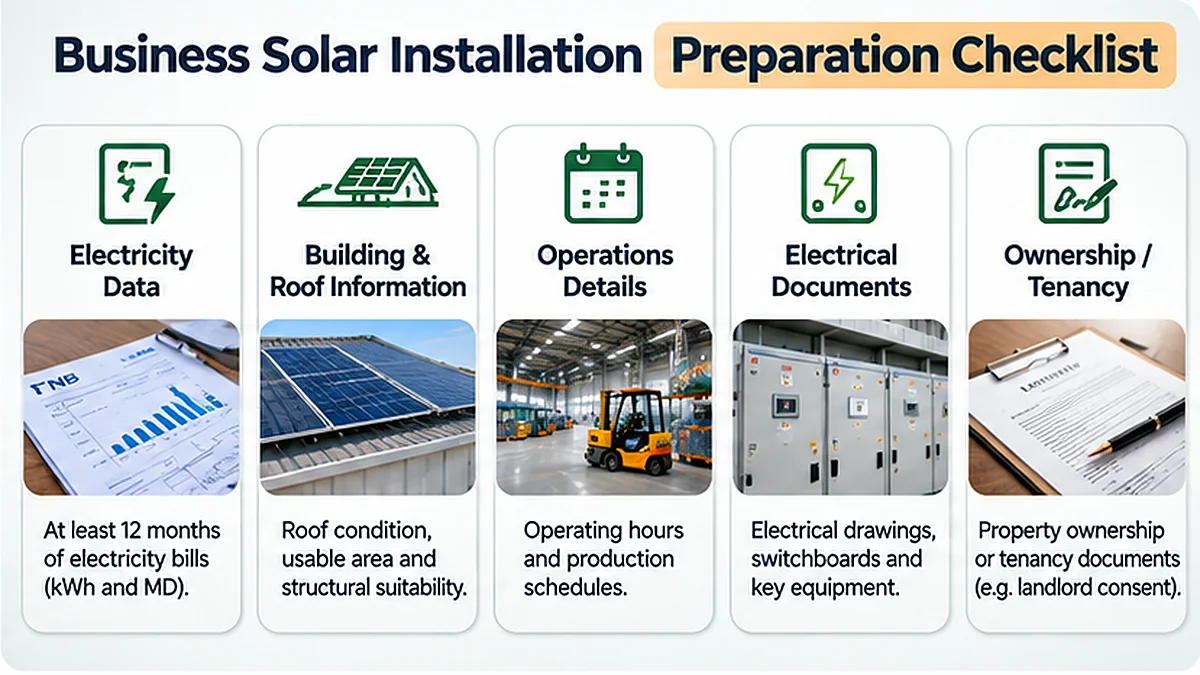
Before contacting a contractor, prepare a basic project information pack.
| Information Required | Why It Matters | Responsible Team |
|---|---|---|
| 12 months of electricity bills | Establishes energy consumption and demand patterns | Finance / Facilities |
| Building and roof information | Helps assess installation space and structural suitability | Facilities |
| Operating hours and production schedules | Identifies daytime electricity demand and possible shutdown windows | Operations |
| Electrical drawings and equipment details | Supports preliminary system integration planning | Engineering / Facilities |
| Property ownership or tenancy documents | Helps establish installation rights and consent requirements | Management / Legal |
You do not need a completed engineering design at this stage. The purpose is to supply enough reliable information for a meaningful feasibility assessment.
Appoint one internal project coordinator who can consolidate information and communicate decisions.
Step 1: Review Your Business Electricity Consumption
A solar installation should be planned around electricity demand, not simply the size of the roof.
Review at least 12 months of electricity records where available, including monthly kWh consumption, recorded Maximum Demand and applicable tariff information.
Pay particular attention to when electricity is used.
For example, a factory operating machinery during daylight hours may consume solar generation directly. A warehouse operating mainly at night may have a different consumption profile despite having similar monthly electricity usage.
Example: Estimating the Scale of Business Electricity Demand
Consider a hypothetical business consuming 48,000 kWh per month.
| Measurement | Illustrative Value |
|---|---|
| Monthly consumption | 48,000 kWh |
| Annual consumption | 576,000 kWh |
| Proposed solar capacity | 250 kWp |
| Assumed annual solar yield | 1,150 kWh/kWp |
| Estimated annual generation | 287,500 kWh |
The generation estimate represents approximately 50% of annual electricity consumption.
However, that does not mean the business will automatically reduce grid purchases by 50%.
Actual results depend on daytime consumption, weather, system losses, exports and the applicable programme.
These figures are hypothetical planning assumptions, not measured Malaysian generation averages or a recommended system size. A contractor should use location-specific modelling, such as PVGIS or equivalent engineering tools, for project forecasts.
Step 2: Assess Whether Your Building Is Suitable for Solar
The next step is to assess the proposed installation area.
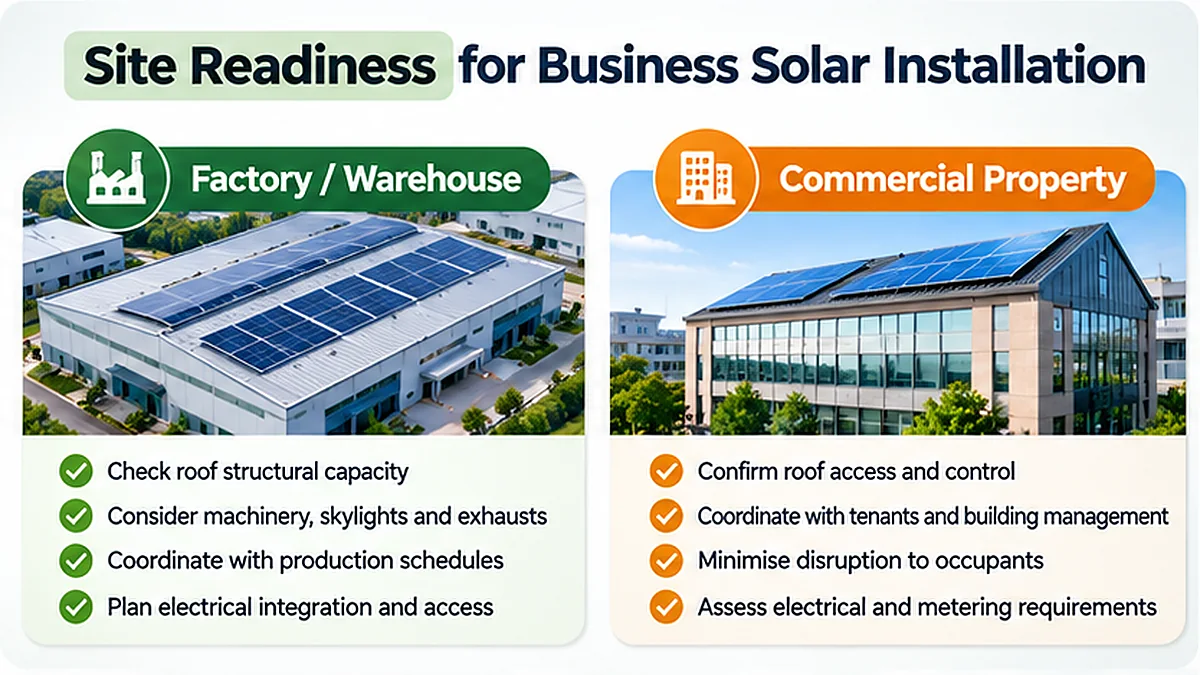
For most commercial and industrial projects, this involves examining the rooftop, although ground-mounted systems or solar carports may also be considered.
What Should Factories and Warehouses Check?
Factories often have large roof areas, but usable space can be affected by structural capacity, machinery exhaust systems, skylights and future expansion plans.
The initial assessment should examine:
Roof age, condition and structural load capacity.
Shading from nearby buildings, equipment or trees.
Existing switchboards and electrical distribution systems.
Cable routes, inverter locations and maintenance access.
Potential interference with production or warehouse activities.
For facilities with demanding operating conditions, professional industrial solar panel installation planning should also consider production schedules, planned shutdowns and long-term equipment access.
What About Offices and Commercial Properties?
Offices, shopping centres, hotels and other commercial properties may need additional coordination with tenants, building management and occupants.
For commercial solar projects, early planning should establish who controls the roof, who holds the electricity account, which areas are accessible and whether construction affects occupied spaces.
Two buildings with similar roof areas may therefore require very different installation arrangements.
Step 3: Confirm the Solar Programme and Approval Requirements
Before finalising system capacity, determine which regulatory framework applies.
For eligible TNB non-domestic consumers in Peninsular Malaysia, Solar ATAP allows on-site solar generation and qualifying surplus-energy exports.
According to SEDA Malaysia, non-domestic Solar ATAP installations are subject to a capacity limit of 100% of Maximum Demand or 1 MW, whichever is lower, along with applicable technical requirements.
The technical assessment process also depends on capacity and voltage level.
For example:
Installations up to 72 kW fall within the category that does not require the published Solar ATAP Connection Assessment Study (CAS).
Installations above 72 kW may require a CAS.
High-voltage connections may require a Power System Study (PSS).
These figures relate specifically to Solar ATAP. They should not be applied automatically to every solar installation scheme.
The project’s nominated provider should verify the current requirements, determine eligibility and coordinate relevant submissions.
EFS Group’s Solar ATAP solutions page explains the programme’s broader application to businesses.
For self-consumption projects outside Solar ATAP, different conditions may apply under the Energy Commission’s applicable guidelines.
Do not schedule installation or assume a commissioning date until the necessary technical assessments and approval dependencies have been identified.
Step 4: Assign Project Responsibilities Before Appointing a Contractor
One common source of delay is unclear responsibility between the business and the solar contractor.
A facility manager may assume procurement has arranged building access, while procurement expects the contractor to handle everything.
Avoid this by creating a simple responsibility matrix.
| Team | Main Responsibility |
|---|---|
| Management | Approve project objectives and major decisions |
| Finance / Procurement | Review commercial terms, warranties and contractual scope |
| Facilities / Engineering | Provide site information, coordinate access and review technical requirements |
| Operations / Safety | Plan work areas, shutdowns and safety coordination |
| Solar Contractor | Deliver agreed design, procurement, construction, testing and commissioning activities |
These are suggested owner-side roles, not a universal contractual allocation.
For a full project delivery arrangement, the EPCC services scope should establish which tasks the contractor performs and which approvals, information or site arrangements remain with the owner.
A short weekly meeting during active project delivery can help track decisions, outstanding documents and critical dependencies.
Step 5: Compare Solar Installation Proposals Properly
Once the site information and project requirements are available, request proposals based on the same assessment criteria.
Do not compare quotations using system capacity or total price alone.
A useful proposal should explain:
Proposed solar PV capacity in kWp and inverter capacity in kWac.
Expected annual electricity generation and modelling assumptions.
Equipment specifications, including panels, inverters and monitoring.
Structural, electrical and other installation work included.
Exclusions, authority submissions and approval responsibilities.
Construction milestones, warranties and handover requirements.
Request clarification for any item listed as provisional or excluded.
For example, a quotation may include rooftop solar modules but exclude switchboard upgrades or additional structural works. Those exclusions can materially affect the final project scope.
Procurement should also verify the contractor’s relevant credentials, project experience and use of appropriately qualified personnel.
Step 6: Organise Construction Around Business Operations
Solar installation can involve rooftop activities, material deliveries, lifting operations, cable installation and electrical integration.
These activities should be coordinated with your existing business operations.
Plan Access, Safety and Shutdowns
Before work begins, agree on:
Delivery routes and material storage areas.
Restricted zones around active construction work.
Rooftop access and relevant safety procedures.
Approved working hours and contractor supervision.
Electrical isolation and planned shutdown windows.
Emergency contacts and incident reporting arrangements.
Malaysia’s Department of Occupational Safety and Health (DOSH) advises employers to assess roof safety, weather conditions, fall hazards and suitable protective measures when planning work at height.
Solar installation personnel should carry out the work under the appropriate safety arrangements. Building owners should not attempt electrical or rooftop installation themselves.
Coordinate Around Production Schedules
Electrical integration may require a planned interruption to certain business operations.
Schedule potentially disruptive work during approved maintenance windows where practical.
For manufacturing facilities, this may mean coordinating with production managers before shutting down machinery or disconnecting electrical equipment.
If you are still assessing whether your factory is suitable for solar, EFS’s guide to solar for manufacturers offers additional background.
Step 7: Agree on a Milestone-Based Installation Timeline
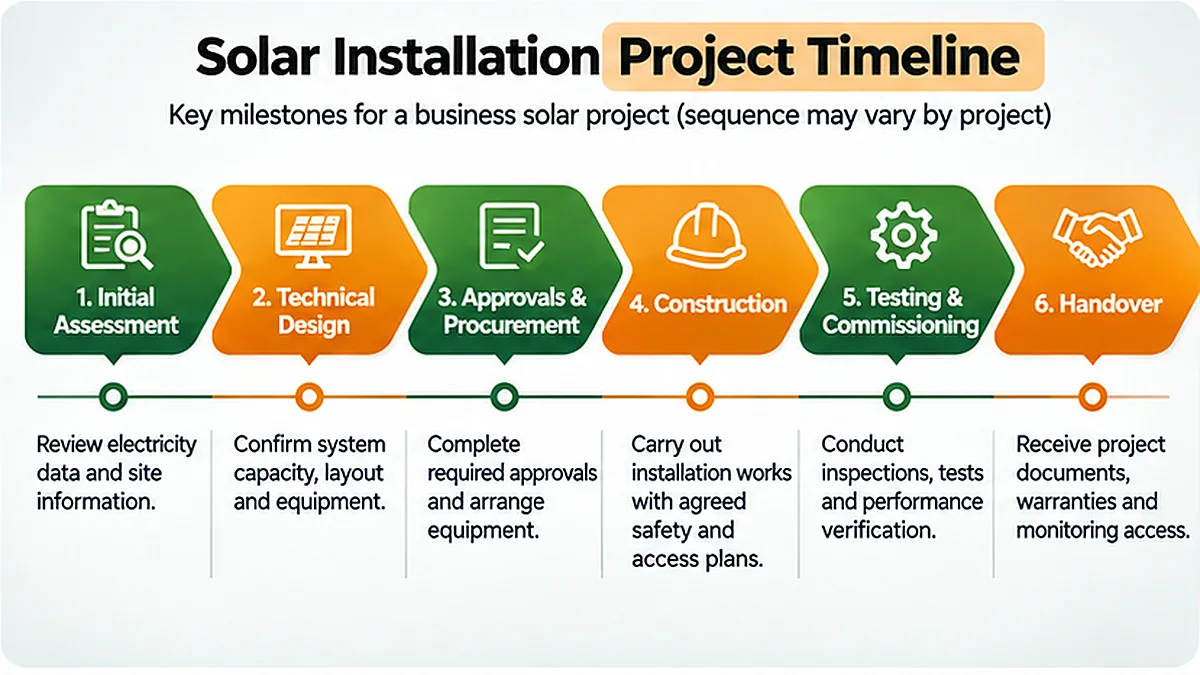
There is no single installation timeframe that applies to every Malaysian business.
Project duration depends on roof conditions, installation capacity, approvals, equipment availability and operational restrictions.
Instead of relying on a promised completion date alone, request a schedule based on the following milestones.
| Project Milestone | What the Owner Should Confirm |
|---|---|
| Initial assessment | Electricity data and site information are complete |
| Technical design | Drawings, equipment and capacity are reviewed |
| Approvals and procurement | Required approvals and equipment arrangements are confirmed |
| Construction | Site access, safety controls and work schedules are agreed |
| Testing and commissioning | Required inspections and test records are completed |
| Final handover | Documentation, monitoring access and outstanding defects are addressed |
Use this as a sequence, not a fixed national timetable.
Some activities can overlap, but regulatory dependencies and safe working requirements should take priority.
A good project schedule identifies who is responsible for each milestone, what must be completed first and what evidence is required before the next stage proceeds.
Step 8: Check Commissioning and Handover Before Accepting the System
Installation is not complete simply because the panels are mounted and the inverter can operate.
The system must undergo the relevant checks before acceptance and operational handover.
The international standard IEC 62446-1 covers documentation, commissioning tests and inspection for grid-connected PV systems.
A practical handover checklist should include:
Final as-built drawings and relevant electrical diagrams.
Equipment datasheets, serial records and operating manuals.
Commissioning reports and applicable certifications.
Warranty documentation and defect-reporting procedures.
Monitoring platform access and user training.
Safety instructions and operating procedures.
Agreed maintenance arrangements.
Where applicable, ensure the required utility metering and contractual processes have also been completed before assuming export credits or billing arrangements are active.
After commissioning, ongoing solar operation and maintenance can support system monitoring, inspections, fault identification and long-term performance.
Final Solar Installation Checklist for Malaysian Businesses
Before approving the project, confirm the following:
Electricity bills and demand data have been collected.
The site and roof have been assessed by qualified personnel.
An internal project coordinator has been appointed.
The applicable solar programme and approval pathway are understood.
The contractor’s scope, equipment and exclusions are documented.
Operations and safety teams have agreed on site access and shutdown arrangements.
Construction milestones and acceptance criteria are defined.
Commissioning and handover documents are included in the contract.
The objective is not simply to install solar panels. It is to deliver a system that your business can operate safely and manage effectively.
Conclusion: Prepare the Business Before Installation Begins
Planning commercial or industrial solar starts with understanding your facility, not selecting equipment.
Reliable electricity data, a suitable installation site, clear project responsibilities and realistic milestones can help businesses make informed decisions before construction.
EFS Group has over a decade of experience in renewable energy, with more than 300 MWp of solar capacity delivered across Malaysia and the region.
We support businesses through feasibility assessments, engineering, procurement, installation, commissioning and long-term solar maintenance. Contact EFS Group to arrange a site assessment and discuss your project’s requirements.