
Key Takeaways
Existing solar panels may need professional removal before major roofing or renovation work, depending on which areas are affected.
Solar panel removal and reinstallation should be coordinated with the roofing contractor to protect the equipment, roof and electrical system.
Reusing the same panels is different from redesigning or upgrading the solar installation.
Changes to system capacity or configuration may require technical reassessment and approval under the applicable Malaysian solar programme.
Before restarting the system, request appropriate electrical testing, inspection records and updated documentation.
Can you renovate a house that already has solar panels? Yes. However, roof replacement, structural changes or extensions can affect the existing solar installation. A qualified solar contractor should assess whether the panels must be temporarily removed, how they will be protected and what checks are needed before reinstallation.
For Malaysian homeowners, the challenge is coordinating two different types of work: building renovation and solar electrical work.
Before renovating a home with a solar panel system, review its existing layout, equipment condition and installation records. This can help prevent unnecessary damage, delays and unexpected changes to the system.
When Do Solar Panels Need to Be Removed for Renovation?
Not every renovation requires solar panel removal.
The deciding factor is whether the proposed work affects the panels, mounting structures, roof surface, electrical cabling or access to the installation.
| Renovation Work | Potential Solar Impact | Initial Action |
|---|---|---|
| Interior renovation | Usually limited | Check whether electrical modifications affect solar connections |
| Minor roof repair | Depends on location | Assess access beneath or around the panels |
| Complete roof replacement | Often substantial | Arrange solar removal and roof-work coordination |
| Roof extension or redesign | May affect layout and capacity | Request a revised solar assessment |
| Adding another floor | Major structural and electrical implications | Plan a new engineering review |
For example, repairing a ceiling inside the house may not affect the rooftop system.
However, replacing tiles underneath an existing array usually requires a different approach because roofers need access to the covered surface.
The decision should be based on the actual work area, not the assumption that every renovation requires removing all panels.
Why Should Roof Condition Be Checked Before Reinstallation?
Solar panels commonly remain in service for decades. The US Department of Energy reports that the average operational lifespan of solar panels has reached approximately 25 to 35 years, based on a 2025 industry survey.
This is an international lifespan estimate, not a warranty for every solar panel installed in Malaysia.
If an existing array is removed to replace roof tiles or waterproofing, the homeowner has an opportunity to address problems that would otherwise remain difficult to access.
A roofing assessment should consider:
Damaged tiles, corrosion or deteriorated roof materials.
Existing waterproofing and signs of leakage.
Structural condition and suitability for the solar mounting system.
Roof penetrations, flashings and mounting attachment points.
Drainage, shading and safe maintenance access.
The solar contractor should separately assess whether the existing mounting hardware and electrical components remain suitable.
Replacing the roof does not automatically mean the original mounting arrangement can be reused without inspection.
How Should Solar Panel Removal and Roof Repairs Be Coordinated?
Successful solar panel removal and reinstallation requires the solar contractor and roofing contractor to agree on their respective responsibilities.
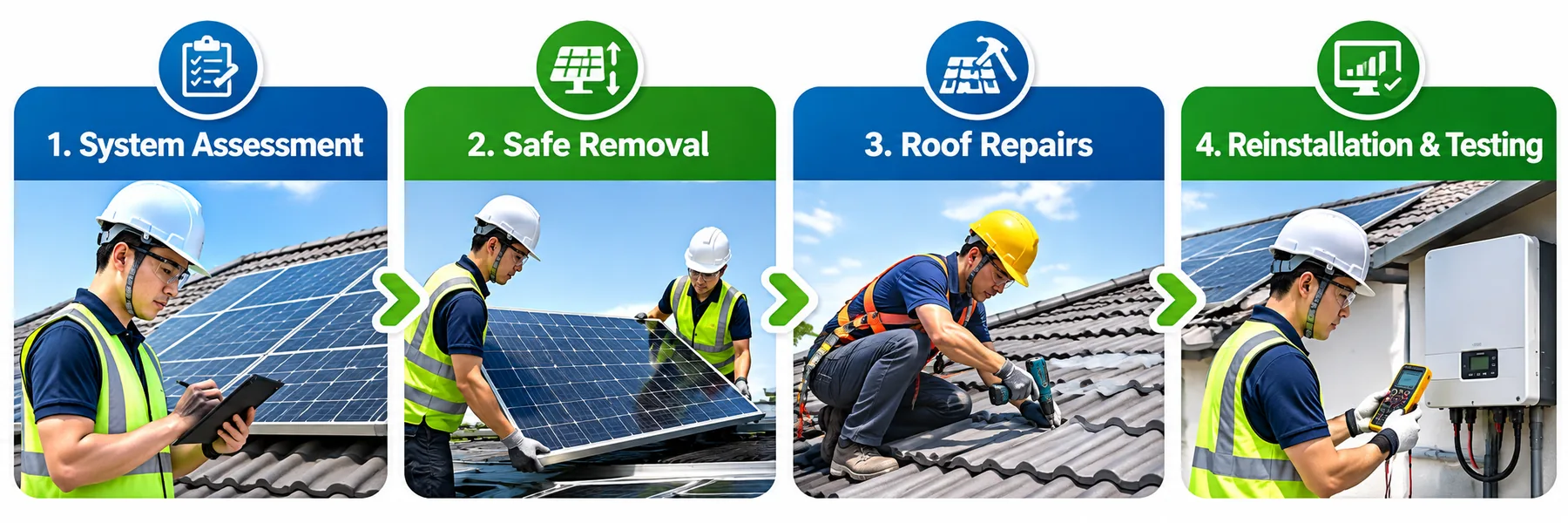
Step 1: Review the Existing Solar Installation
Start by collecting the original installation drawings, inverter details, warranty documents and recent solar generation records.
Ask a qualified solar service provider to assess the panels, mounting structures, cabling and electrical condition.
The inspection should establish whether the system can be temporarily removed and reinstated or whether certain components require replacement.
Step 2: Agree on Electrical Safety Arrangements
Solar equipment presents electrical hazards even when ordinary household power arrangements are interrupted.
The appropriate solar and electrical personnel must manage isolation, disconnection, verification and subsequent reconnection.
Malaysia’s Energy Commission requires individuals carrying out, supervising or taking responsibility for electrical works to hold the applicable competency certification.
Do not allow general renovation workers to disconnect solar cables or remove electrical components without the relevant expertise.
Step 3: Arrange Removal and Secure Storage
If panels must be removed, the responsible solar contractor should document their original positions and check their condition.
The homeowner should confirm how components will be labelled, transported, stored and protected against physical damage.
Suitable storage arrangements are important if roof repairs extend beyond the original schedule.
Step 4: Complete Roof Repairs Before Reinstallation
The roofing contractor should finish the agreed structural, waterproofing and roof-covering work before the solar system is reinstated.
The solar contractor should then verify that the repaired roof can accommodate the approved mounting layout.
Malaysia’s Department of Occupational Safety and Health also emphasises planning, fall prevention and suitable working conditions for roof work.
These responsibilities should be coordinated rather than leaving each contractor to assume the other has addressed them.
Can You Reinstall the Same Solar Panels After Roof Replacement?
Yes, existing panels can often be reused if their condition, compatibility and the revised roof arrangement are suitable.
However, the solar contractor should inspect the system before confirming reinstallation.
Components that deserve particular attention include mounting brackets, rails, connectors, cables, earthing arrangements and the inverter.
The original layout may need adjustment if the roof has new obstacles or a different shape.
For example, a newly installed skylight, extended balcony roof or additional rooftop equipment could reduce usable space.
The important distinction is that reinstallation aims to restore the existing system, while upgrading changes its design or capacity.
Homeowners whose roof layout or electricity needs have changed can arrange a residential solar panel installation assessment to determine whether the existing configuration remains appropriate.
What Happens if Your Renovated Roof Has Less Space?
Consider a hypothetical home with 12 solar panels rated at 450 W each.
Before renovation, the system has a total DC capacity of:
12 × 450 W = 5,400 W, or 5.4 kWp
Suppose a roof extension leaves space for only nine of those panels.
| Measurement | Original System | Revised Layout |
|---|---|---|
| Number of panels | 12 | 9 |
| Panel rating | 450 W | 450 W |
| Total DC capacity | 5.4 kWp | 4.05 kWp |
| Capacity reduction | None | 25% |
The revised layout has 25% less rated DC capacity.
That does not automatically mean electricity generation or bill savings will fall by exactly 25%. Actual performance also depends on panel orientation, shading, weather and electrical design.
A solar engineer should first investigate whether all 12 panels can be accommodated elsewhere on the renovated roof.
If not, reducing capacity or redesigning the system becomes a decision requiring further assessment.
Should You Upgrade Your Solar Panels During Renovation?
Renovation can be a convenient opportunity to consider a solar panel upgrade, particularly if household electricity consumption has changed.
For example, homeowners may now use more electricity because of additional air conditioners, home office equipment or an electric vehicle.
However, adding solar panels to an existing system is not a plug-and-play process.
The contractor should check:
Compatibility between existing and proposed solar modules.
Inverter capacity and electrical configuration.
Available roof area and structural suitability.
Electricity consumption and daytime demand.
Applicable technical assessments and programme conditions.
Newer panels may offer different wattage and electrical characteristics from older modules.
Likewise, increasing panel capacity may require changes to the inverter or other system components.
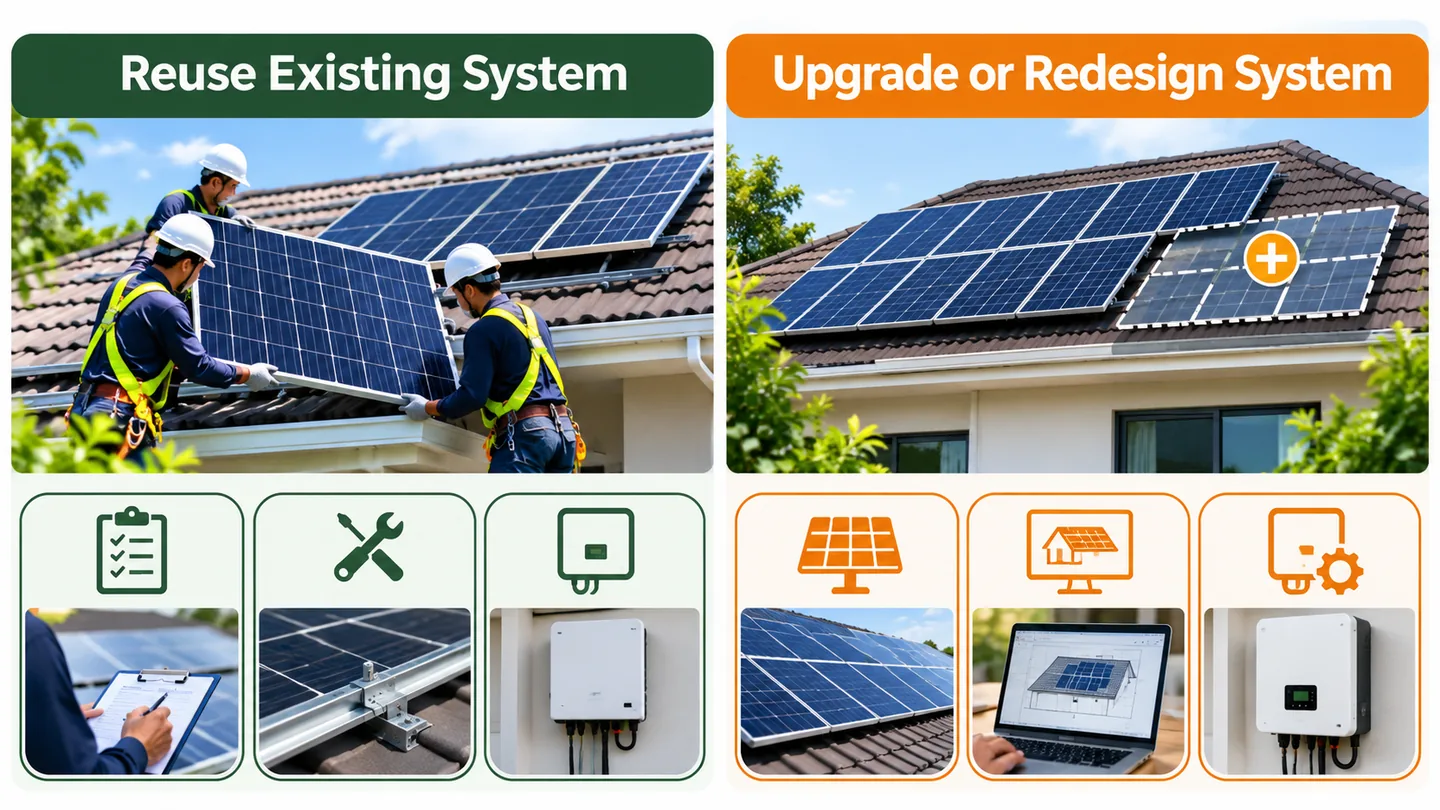
A renovation provides an opportunity to reassess solar capacity, not an automatic reason to replace working equipment.
Will Renovation Affect Your NEM or Solar ATAP Agreement?
This is an important consideration for Malaysian homeowners with existing grid-connected systems.
An installation operating under an earlier Net Energy Metering (NEM) agreement should not automatically be treated as a new Solar ATAP installation.
Similarly, temporarily removing panels for roof work is different from increasing capacity, moving the system to another premises or changing the approved electrical design.
The contractor should review the applicable agreement before making changes.
Under Malaysia’s current Solar ATAP framework, standard domestic capacity thresholds are:
| Electricity Supply | Standard Capacity Threshold |
|---|---|
| Single-phase | 5 kW |
| Three-phase | 15 kW |
Installations exceeding the relevant threshold are subject to a Connection Confirmation Check (CCC), with an official study fee of RM1,000.
These are Solar ATAP programme requirements and should not be applied automatically to every older NEM installation.
Homeowners considering a capacity increase should review the applicable Solar ATAP requirements and confirm whether revised documentation or approvals are necessary.
Do not assume that an existing export-credit arrangement will remain unchanged after a system modification.
How Much Downtime Should You Expect?
There is no universal removal-and-reinstallation timeline.
The duration depends on the number of panels, accessibility, roof-repair scope, weather, component condition and whether redesign or additional approvals are needed.
Downtime also affects electricity generation.
For illustration, suppose a rooftop system normally generates an average of 15 kWh per day.
If it remains out of service for 14 days:
15 kWh × 14 days = 210 kWh
That represents 210 kWh of potential solar generation not produced during the assumed period.
Actual generation would depend on weather and system performance. This is not a fixed electricity-bill loss or Malaysian production benchmark.
Rather than rely on a standard number of days, agree on the sequence of removal, roofing work, inspection, reinstallation and testing before renovation starts.
What Should Be Checked Before Reconnecting the System?
Reinstallation is not complete simply because the panels have been placed back on the roof.
The responsible solar personnel should verify that the equipment has been correctly installed and remains safe to operate.
International standard IEC 62446-1 provides guidance on documentation, commissioning tests and inspection for grid-connected photovoltaic systems.
Relevant post-reinstallation checks may include physical condition, mounting integrity, electrical connections, protection arrangements, inverter operation and monitoring.
Testing should be appropriate to the work performed and the applicable technical requirements.
Where panel damage, recurring inverter alarms or reduced generation are identified, professional solar panel maintenance services can support fault diagnosis, inspection and performance assessment.
Homeowners should obtain relevant test records before accepting the restored system.
What Should Be Included in a Removal and Reinstallation Quotation?
A quotation should distinguish solar work from roofing work.
Otherwise, the homeowner may approve the renovation without understanding which contractor is responsible for each task.
Ask whether the proposal includes panel removal, electrical isolation, temporary storage, replacement mounting materials, reinstallation, testing and documentation.
It should also identify:
Which components can be reused and which are excluded.
Who handles accidental damage during removal or storage.
Whether waterproofing and roof penetrations are covered.
Responsibility for unexpected equipment defects.
Any required redesign, approval or additional work.
If separate roofing and solar contractors are involved, request a clear division of responsibility.
The lowest quotation is not necessarily the most complete when important reinstatement work has been excluded.
Home Renovation Solar Checklist
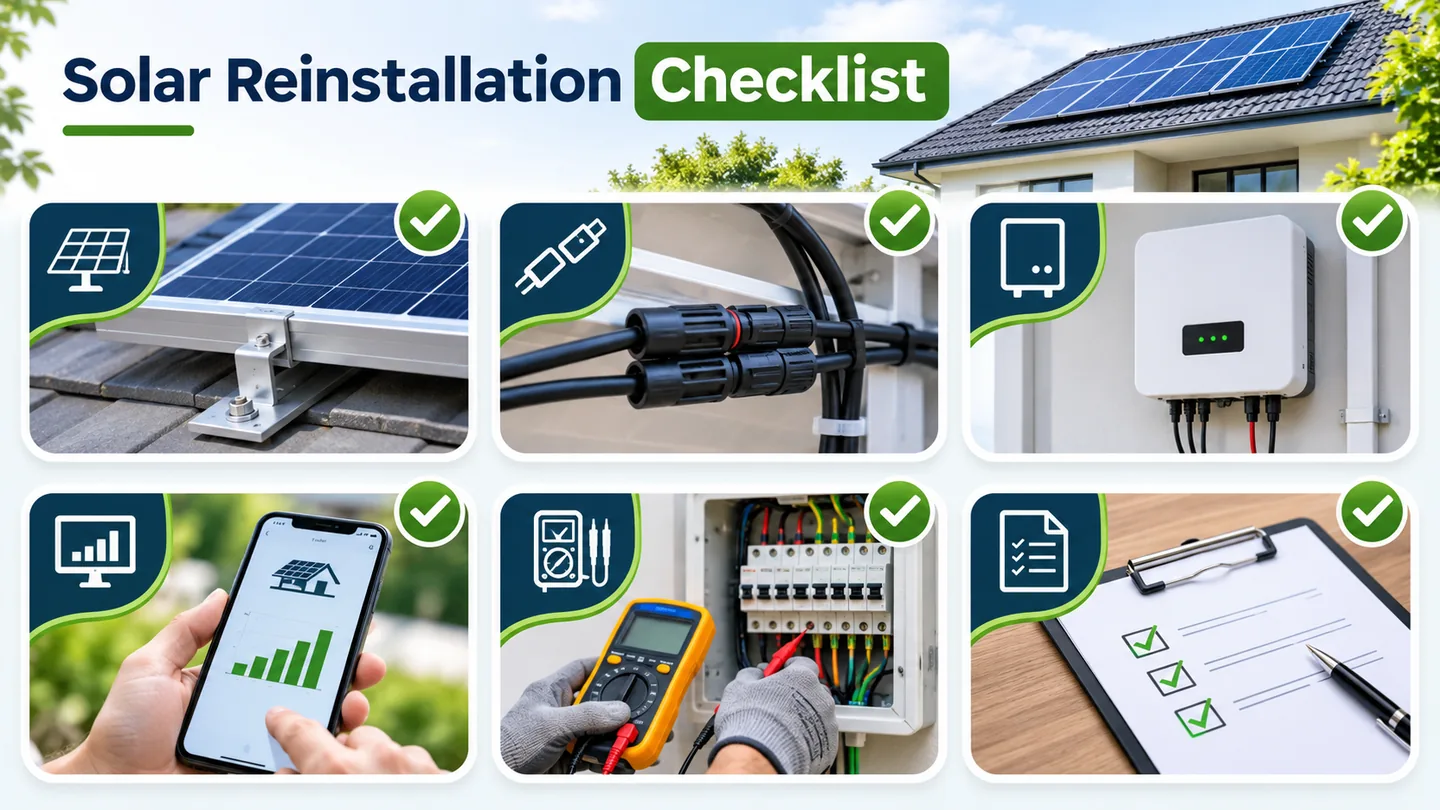
Before renovation begins, confirm that:
- The existing system’s drawings, warranties and installation records are available.
- A qualified solar contractor has inspected the affected equipment.
- The roofing and solar contractors agree on their work sequence.
- Electrical isolation and rooftop safety arrangements have been planned.
- Panel removal, handling and storage responsibilities are documented.
- The repaired roof has been assessed for mounting suitability.
- Any capacity or layout changes have been reviewed for approval implications.
- Required testing and updated records will be provided after reinstallation.
A homeowner should also retain before-and-after photographs, relevant invoices and commissioning records for future maintenance or warranty enquiries.
Conclusion: Renovate the Roof Without Overlooking the Solar System
Renovating a home with solar panels requires coordination between building work and solar electrical work.
By assessing the existing installation early, homeowners can decide whether panels need temporary removal, whether roof repairs affect the mounting arrangement and whether the original system can be safely reinstated.
For larger changes, the project may require a revised solar design rather than straightforward reinstallation.
EFS Group provides residential solar assessment, engineering, installation and maintenance support in Malaysia. Homeowners planning roof renovation can discuss their existing system with EFS Group to understand the technical assessment needed before proceeding.