Key Takeaways
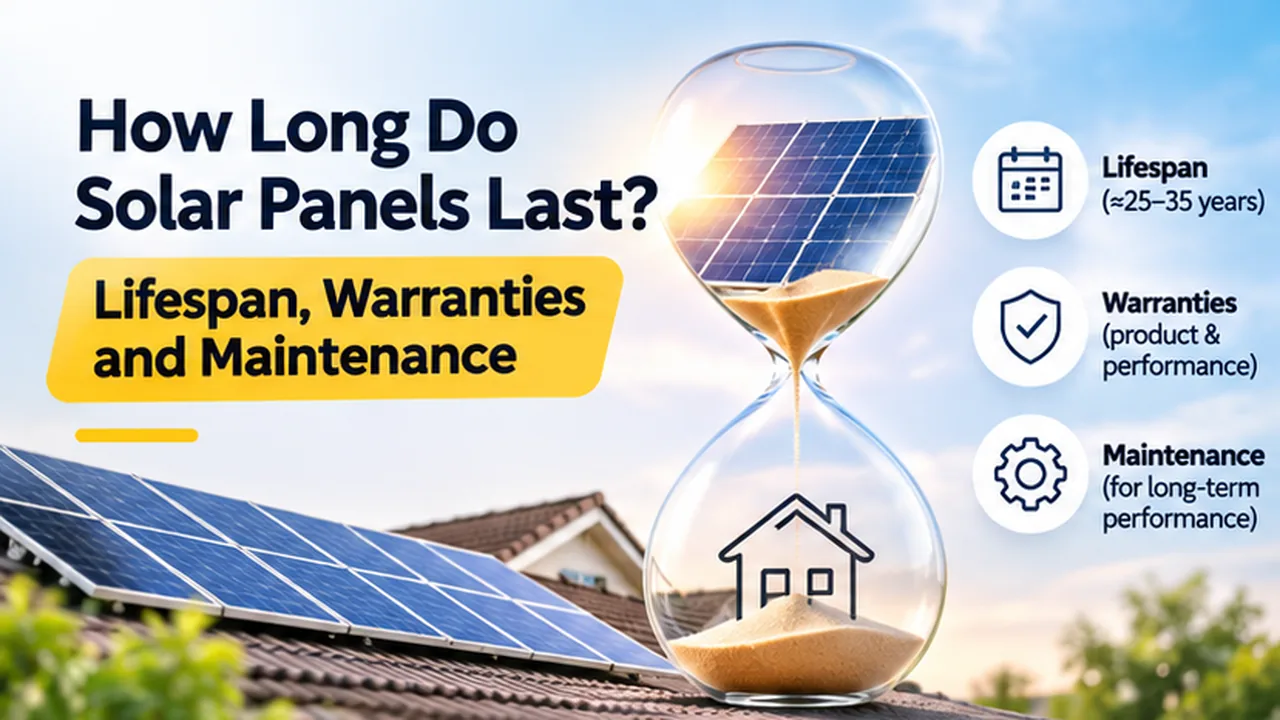
Solar panels commonly operate for 25–35 years, although actual lifespan depends on equipment quality, site conditions and maintenance.
A 25-year performance warranty does not mean a panel stops working after 25 years.
Product warranties, performance warranties and installation workmanship warranties cover different risks.
Inverters, wiring, mounting systems and optional batteries have separate maintenance and replacement requirements.
Declining electricity generation does not automatically mean your solar panels need replacing. Fault diagnosis should come first.
How long do solar panels last? Modern solar panels commonly operate for 25–35 years, according to international industry research. However, their electricity output gradually changes with age, and the inverter or other components may require attention earlier. A panel’s lifespan is not the same as its warranty period.
For homeowners comparing solar panel providers in Malaysia, long-term reliability should be as important as initial system capacity and installation quality.
Understanding how solar equipment ages helps you maintain your system, interpret warranty claims and decide whether repairs or replacement are necessary.
How Many Years Do Solar Panels Actually Last?
Solar panels do not have a universal expiry date.
The US Department of Energy reports that a 2025 survey of American solar industry professionals found an average operational lifespan of 25–35 years, compared with approximately 20 years in 2007.
This is international industry evidence rather than a guaranteed Malaysian lifespan.
A panel can remain operational after its warranty expires, provided it is electrically safe, structurally sound and generating electricity at an acceptable level.
Three factors determine whether a system remains useful:
Physical condition: Panels, mounting structures and electrical connections remain safe and serviceable.
Actual performance: Electricity generation remains reasonable after accounting for weather, system age and other operating conditions.
Repair feasibility: Replacement parts, compatible equipment and technical support remain available.
Therefore, a 25-year-old system with stable performance may not need full replacement, while a newer installation with damaged components may require immediate attention.
What Does a 25-Year or 30-Year Solar Panel Warranty Mean?
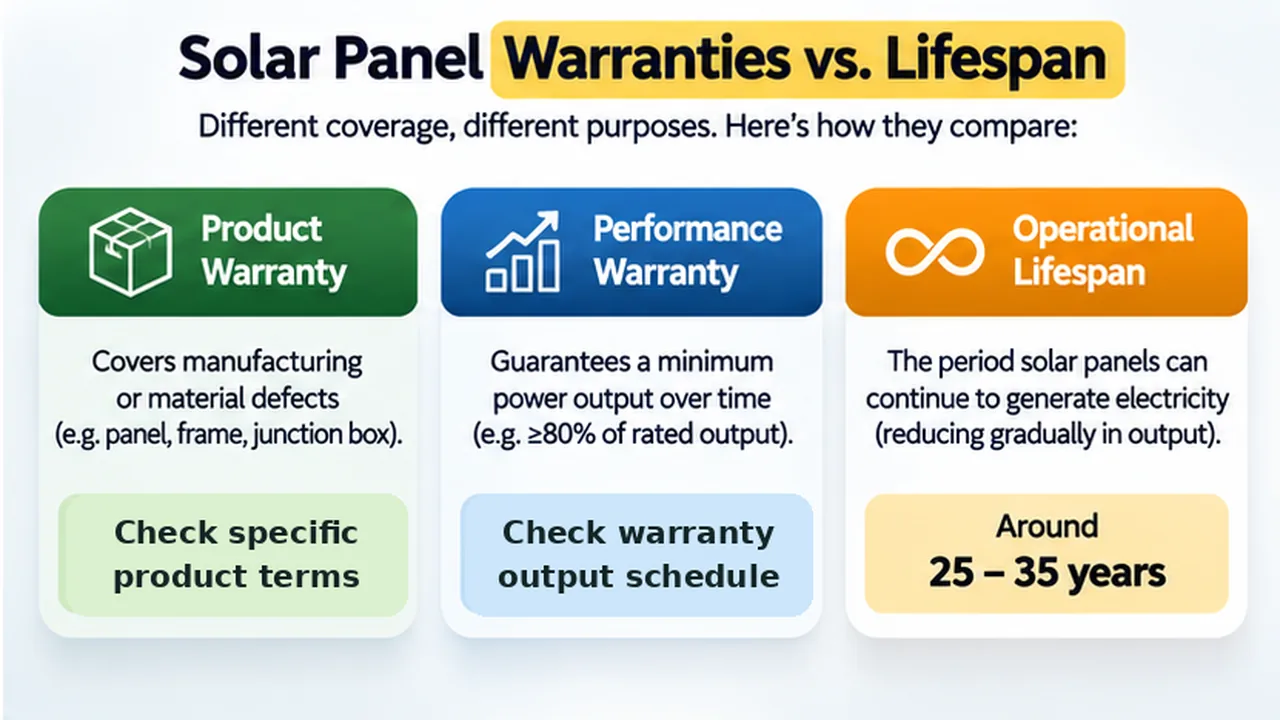
Solar warranties protect against different problems. They should not be treated as interchangeable.
| Warranty Type | What It Covers | What to Verify |
|---|---|---|
| Product warranty | Manufacturing or material defects | Exact components, period and exclusions |
| Performance warranty | Manufacturer’s specified minimum panel output | Degradation schedule and test conditions |
| Workmanship warranty | Defined installation defects | Installer responsibilities and coverage |
| Inverter warranty | Eligible inverter faults | Manufacturer terms, period and claim process |
Product Warranty: Protection Against Defects
A product warranty addresses qualifying manufacturing defects and material failures.
Coverage depends on the manufacturer and exact panel model. It may exclude damage caused by improper installation, unauthorised modifications or external events.
Always request the product warranty document rather than relying solely on a sales brochure.
Performance Warranty: Guaranteed Minimum Output
A performance warranty specifies the minimum output a solar module should retain over a defined period under stated test conditions.
For example, a hypothetical 25-year warranty could specify a minimum of 80% of rated power at the end of the period.
That does not mean every panel will lose 20%, or that household electricity generation is guaranteed to remain at 80% under all weather conditions.
Some manufacturers offer different performance curves, first-year allowances and warranty durations.
Workmanship Warranty: Installation Quality
The solar installer may provide separate coverage for specified installation defects.
This can involve mounting, wiring or other installation-related workmanship, subject to contractual exclusions.
For new buyers, comparing residential solar panel installation proposals should include the exact panel and inverter models, warranty documents, installer responsibilities and after-sales arrangements.
The most useful comparison is model-specific warranty coverage, not the largest number advertised.
How Does Solar Panel Output Change Over Time?
Solar panels gradually lose some of their original power-producing capability. This process is called degradation.
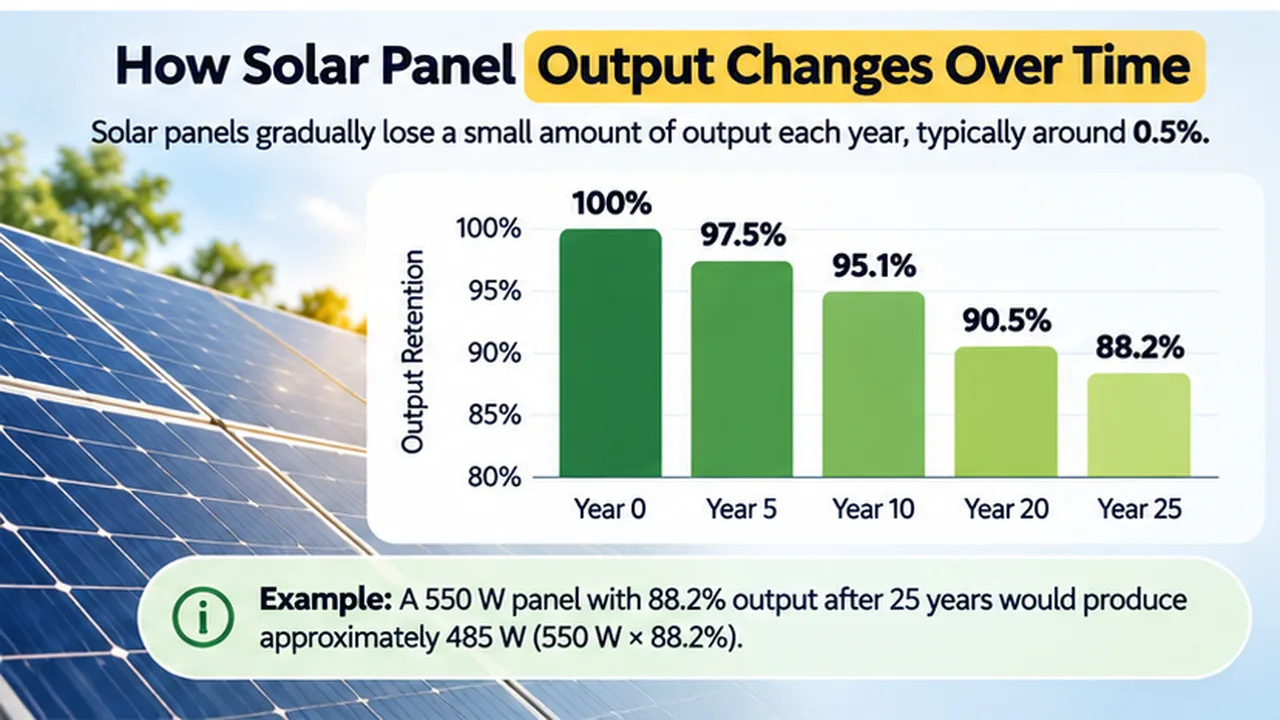
The US Department of Energy identifies approximately 0.5% annual degradation as a commonly used reference in photovoltaic performance assessment.
Actual degradation varies by technology, equipment condition and environment.
Example: What Does 0.5% Annual Degradation Look Like?
Consider a hypothetical panel that loses 0.5% of its remaining rated output each year.
For illustration:
Remaining output percentage = 100 × (1 − 0.005) ^ years
| Years in Operation | Illustrative Output Retention |
|---|---|
| Year 0 | 100% |
| Year 5 | 97.5% |
| Year 10 | 95.1% |
| Year 20 | 90.5% |
| Year 25 | 88.2% |
After 25 years, the model suggests approximately 88.2% of the original rated power remains.
For a hypothetical 550 W module:
550 W × 88.2% = approximately 485 W
This is an illustrative degradation model, not an EFS equipment specification or manufacturer warranty.
It also assumes a constant annual rate from the start. Actual manufacturers may specify different first-year losses and subsequent annual rates.
Does 88.2% Output Retention Mean 88.2% Electricity Generation?
No. Rated output and electricity generated over a month or year are different measurements.
Actual solar generation depends on sunlight, module temperature, shading, dirt, inverter operation and system availability.
For that reason, comparing two electricity bills or two calendar months is not enough to calculate panel degradation.
A technical assessment should compare measured production with expected production under comparable, weather-adjusted conditions.
Which Solar System Components Have Different Lifespans?
A solar PV system contains more than solar panels.
Even if its modules continue working for decades, supporting equipment can develop faults or require replacement at different times.
| Component | Main Function | Long-Term Consideration |
|---|---|---|
| Solar panels | Generate DC electricity | Degradation and physical condition |
| Inverter | Convert DC electricity into usable AC | Electronic faults and serviceability |
| Mounting and cables | Secure and connect equipment | Corrosion, wear and electrical integrity |
| Monitoring system | Track energy production and faults | Communication and software compatibility |
| Optional battery | Store electricity for later use | Battery health, cycles and warranty limits |
Solar Inverters
Inverters contain electronic components that operate under electrical and thermal stress.
A failed inverter can prevent an otherwise functional solar array from delivering electricity.
Replacing a faulty inverter does not automatically require replacing the panels.
The appropriate repair depends on diagnostic findings, equipment compatibility and warranty coverage.
Batteries and Energy Storage
Battery storage has a different ageing mechanism from photovoltaic modules.
Battery health is affected by factors such as operating temperature, charging patterns, cycle count and the manufacturer’s permitted operating conditions.
Homeowners using a BESS system should review battery warranty terms separately, including any capacity-retention guarantees and cycle limitations.
The lifespan of the panels must not be used to estimate the lifespan of the battery.
What Affects Solar Panel Lifespan in Malaysia?
Malaysia’s tropical conditions introduce several practical maintenance considerations.
However, high temperatures and frequent rainfall do not automatically mean solar panels will fail prematurely.
1. Heat and Module Temperature
Solar panel power output is affected by operating temperature.
Panel ratings are measured under standard laboratory conditions, whereas rooftop temperatures change throughout the day.
Adequate design, equipment suitability and ventilation help manage operating conditions.
2. Humidity and Moisture Exposure
Moisture-related problems may affect vulnerable electrical connections, damaged components or poorly protected equipment.
Appropriate sealing, equipment ratings and installation workmanship matter.
3. Dust, Leaves and Bird Droppings
Soiling can reduce the amount of sunlight reaching solar cells.
Rainfall may wash away some surface dirt, but it does not necessarily remove accumulated debris or stubborn contamination.
Properties near industrial activities, construction work or heavy vegetation may need closer attention.
4. Shading and Roof Changes
Growing trees, new buildings or rooftop modifications can change solar exposure over time.
A system performing well when first installed may therefore generate less electricity after its surroundings change.
Good long-term performance depends on the installation environment, not simply the panel’s advertised lifespan.
How Often Should Solar Panels Be Maintained?
Solar panels generally require less routine mechanical maintenance than equipment with moving parts, but the entire PV system still requires monitoring and inspection.
For residential systems, homeowners should monitor generation records and inverter alerts regularly.
Professional inspection frequency should follow manufacturer requirements, site conditions and the system’s maintenance plan.
A practical approach includes:
Monthly monitoring: Review generation trends and inverter notifications.
Condition-based cleaning: Arrange cleaning when soiling is significant or performance data indicates a problem.
Professional inspections: Check electrical equipment, mounting structures, connectors and protection systems according to the agreed schedule.
Fault investigation: Request assistance when alarms, damage or unexplained generation changes appear.
Do not climb onto the roof or open electrical equipment to investigate faults yourself.
Should You Maintain, Repair or Replace Your Solar System?
When electricity generation falls, replacing all the panels should not be the first response.
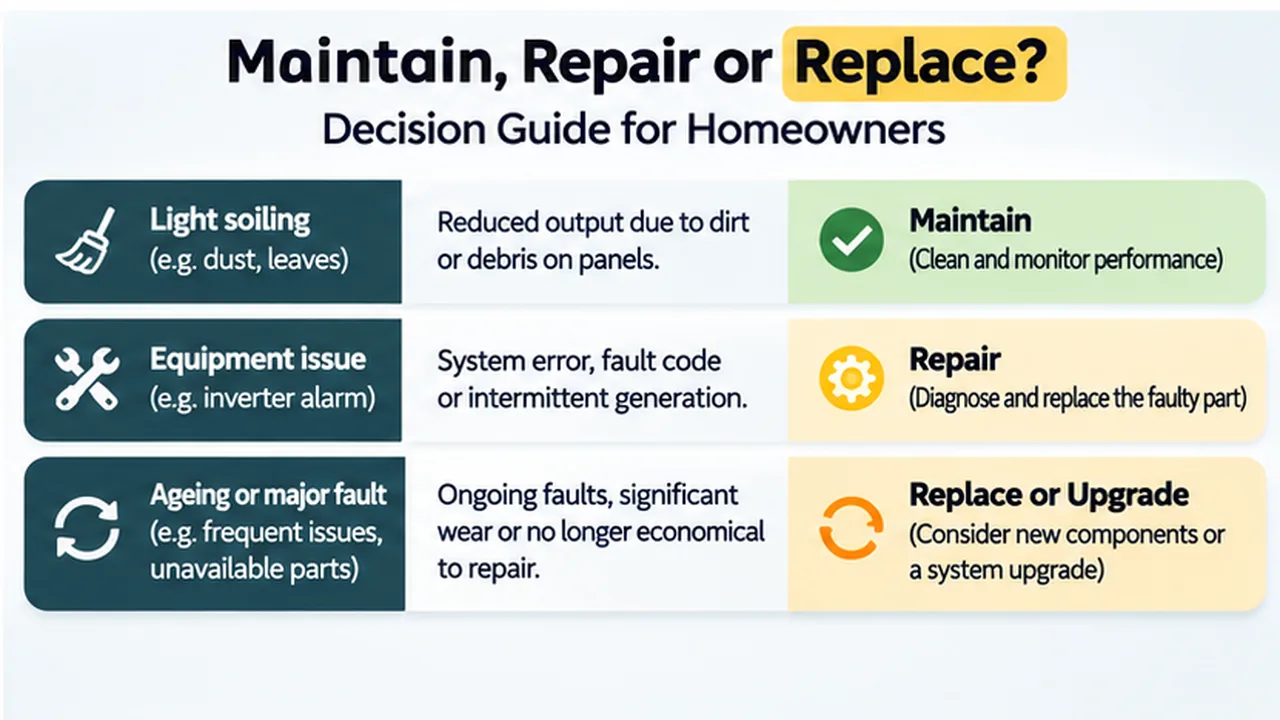
The appropriate decision depends on the actual fault, system age, warranty status and repair feasibility.
| Situation | Recommended Initial Action |
|---|---|
| Heavy dirt or bird droppings | Assess cleaning needs |
| Inverter alarms or communication faults | Diagnose the affected equipment |
| Lower output without visible damage | Compare weather-adjusted performance |
| Cracked panels or damaged cables | Arrange professional safety assessment |
| Repeated faults and unavailable parts | Evaluate component replacement |
| Major roof renovation or structural changes | Review system redesign or reinstallation |
Example: A Sudden Drop in Generation
Suppose a home solar system produced 500 kWh in one month but only 350 kWh during a later month.
The difference is:
(500 − 350) ÷ 500 × 100 = 30%
That represents a 30% reduction in recorded generation between those two periods.
However, it does not establish that the panels degraded by 30%.
Cloudier weather, inverter downtime, shading or monitoring problems may explain part or all of the change.
The correct response is to investigate the cause before approving equipment replacement.
Homeowners experiencing unusual generation losses can arrange solar operation and maintenance support to assess monitoring records, electrical condition and possible faults.
Does the Solar ATAP Contract Determine Panel Lifespan?
No. The Solar ATAP contract period and the physical lifespan of solar panels are separate matters.
SEDA Malaysia states that Solar ATAP contracts run for 10 years.
After that period, the installation may continue operating for self-consumption under the programme’s applicable conditions, but the previous export-credit treatment does not continue.
A 10-year programme period therefore does not mean a solar array must be dismantled or replaced after 10 years.
Homeowners should distinguish between:
The system’s physical operating life.
The manufacturer’s warranties.
The applicable electricity programme and contract conditions.
Existing NEM installations also have their own contractual arrangements. Review those arrangements before changing the installation.
For current programme information, refer to EFS Group’s Solar ATAP solution page.
What Happens When Solar Panels Reach the End of Their Life?
When an ageing solar installation is no longer safe, reliable or economical to repair, the owner has several options.
These include replacing defective components, upgrading selected equipment, redesigning the system or retiring the installation.
Complete replacement is not always necessary.
For example, a functioning array may remain useful after an inverter replacement, provided the components are compatible and the installation meets relevant technical requirements.
If solar modules must be disposed of, homeowners should arrange professional removal and confirm an appropriate recycling or disposal route.
Malaysia’s Department of Environment requires waste classification and handling to follow applicable environmental regulations. Do not assume discarded panels qualify for ordinary household disposal or that free nationwide recycling is available.
Conclusion: Solar Lifespan Depends on More Than Age
Solar panels commonly operate for 25–35 years, but age alone should not determine whether they are replaced.
Long-term reliability depends on panel quality, site conditions, system design, maintenance and the condition of supporting equipment.
Homeowners should understand their warranties, keep performance records and investigate faults before replacing working equipment.
EFS Group supports solar PV installation, monitoring, fault diagnosis and maintenance across Malaysia.
If your existing system is showing reduced generation or recurring faults, contact EFS Group for an assessment of its performance, maintenance history and warranty documentation before making a replacement decision.