Key Takeaways
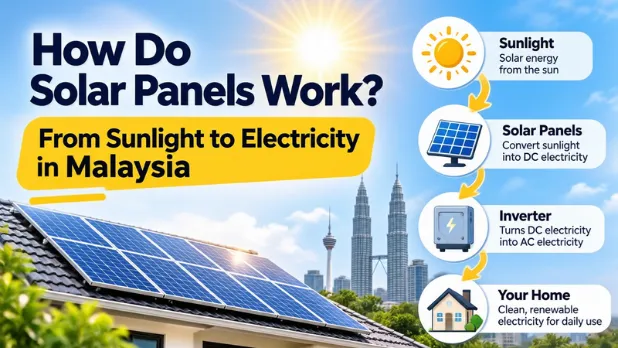
- Solar panels use photovoltaic (PV) cells to convert sunlight directly into electrical energy, without burning fuel.
- A solar inverter converts the direct current (DC) produced by solar panels into alternating current (AC) that buildings can use.
- During daylight hours, solar electricity can supply a property’s electrical needs, while the grid provides additional electricity when required.
- Solar panels can still generate electricity on cloudy days, but their output generally decreases when less sunlight reaches the panels.
- Standard grid-connected solar systems normally shut down during a power outage. Continuing to supply electricity requires an appropriately designed backup system.
Solar panels in Malaysia convert sunlight into electricity through photovoltaic cells while an inverter makes that electricity usable by homes and businesses. In Malaysia, grid-connected systems can work alongside the existing electricity supply to meet a building’s energy needs.
According to SEDA Malaysia’s 2021 Renewable Energy Roadmap, Malaysia’s historical average annual solar irradiation was approximately 1,726 kWh/m², equivalent to around 4.7 kWh/m² per day.
Now that’s the TLDR part, and that’s all well and good.
But what actually happens between sunlight reaching your roof and electricity powering your air conditioner? To understand the process, we will walk you through the process step by step.
How Do Solar Panels Work Step by Step?
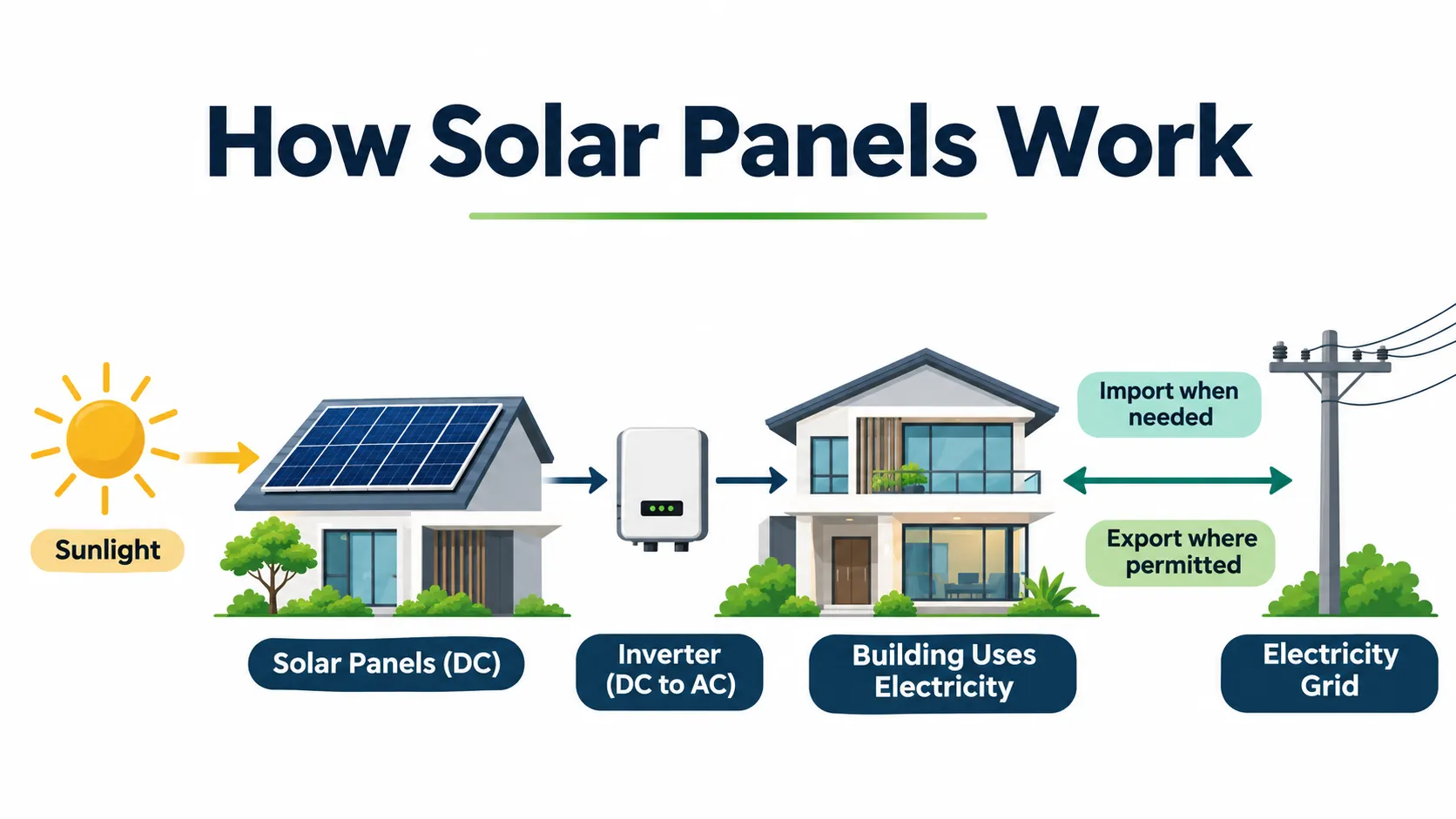
A grid-connected solar photovoltaic (PV) system converts sunlight into usable electricity through a series of connected processes.
 Step 1: Sunlight Reaches the Solar Panels
 Step 1: Sunlight Reaches the Solar Panels
Solar panels consist of multiple photovoltaic cells, commonly made from silicon. When sunlight reaches the photovoltaic cells, its energy allows electrons to move, creating an electrical current.
The process is known as the photovoltaic effect.
Unlike solar thermal systems, PV panels convert light directly into electricity.
The resulting electricity is direct current (DC).
Step 2: The Solar Inverter Converts DC Into AC
Malaysia’s TNB grid operates at a nominal 50 Hz, with 230 V single-phase and 400 V three-phase supplies.
A grid-connected inverter converts DC into compatible AC and meets grid-connection requirements.
This is why an inverter does more than simply convert DC into AC.
For example:
- Solar panels generate DC electricity when exposed to sunlight.
- The inverter converts that DC electricity into AC.
- The converted electricity can supply compatible loads in the building.
Inverters also monitor operating conditions and help maintain the required electrical characteristics for the installation.
Step 3: The Building Uses Solar Electricity
Converted AC electricity can power building equipment.
For solar panel for homes, this may include:
- Refrigerators and freezers.
- Air conditioners.
- Fans and lighting.
- Washing machines.
- Computers and other electrical appliances.
For a business, solar electricity may help supply office equipment, ventilation systems, refrigeration or industrial machinery.
Step 4: The Grid Supplies Electricity When Solar Output Is Insufficient
Solar generation changes throughout the day.
If a building requires more electricity than the solar system is generating, a grid-connected installation can obtain the difference from the electricity network.
Electricity Flow | Power |
Building electricity demand | 5 kW |
Solar PV generation | 3 kW |
Additional electricity from grid | 2 kW |
In this example, solar generation supplies part of the building’s immediate electricity demand, while the grid provides the remainder.
Using solar electricity directly within the property is called self-consumption. When solar output is lower than electricity demand, the grid supplies the difference.
What Are the Main Components of a Solar PV System?
Solar panels are only one part of a complete PV system.
A complete system requires several supporting components.
Component | Main Function |
Solar PV panels | Convert sunlight into DC electricity |
Solar inverter | Converts DC electricity into AC |
Mounting structures | Secure panels to suitable roofs or other structures |
Electrical protection equipment | Supports safe operation and fault protection |
Metering and monitoring | Measures relevant energy flows and system performance |
Electrical cabling and other balance-of-system equipment connect these components.
Monitoring tools can track generation and flag unusual performance.
For Malaysian properties, system configuration must account for the building’s electrical infrastructure, site conditions and relevant connection requirements.
EFS Group provides integrated solar panel installation, covering engineering, procurement, installation, commissioning and long-term operational support.
How Do Solar Panels Work During Malaysia’s Different Weather Conditions?
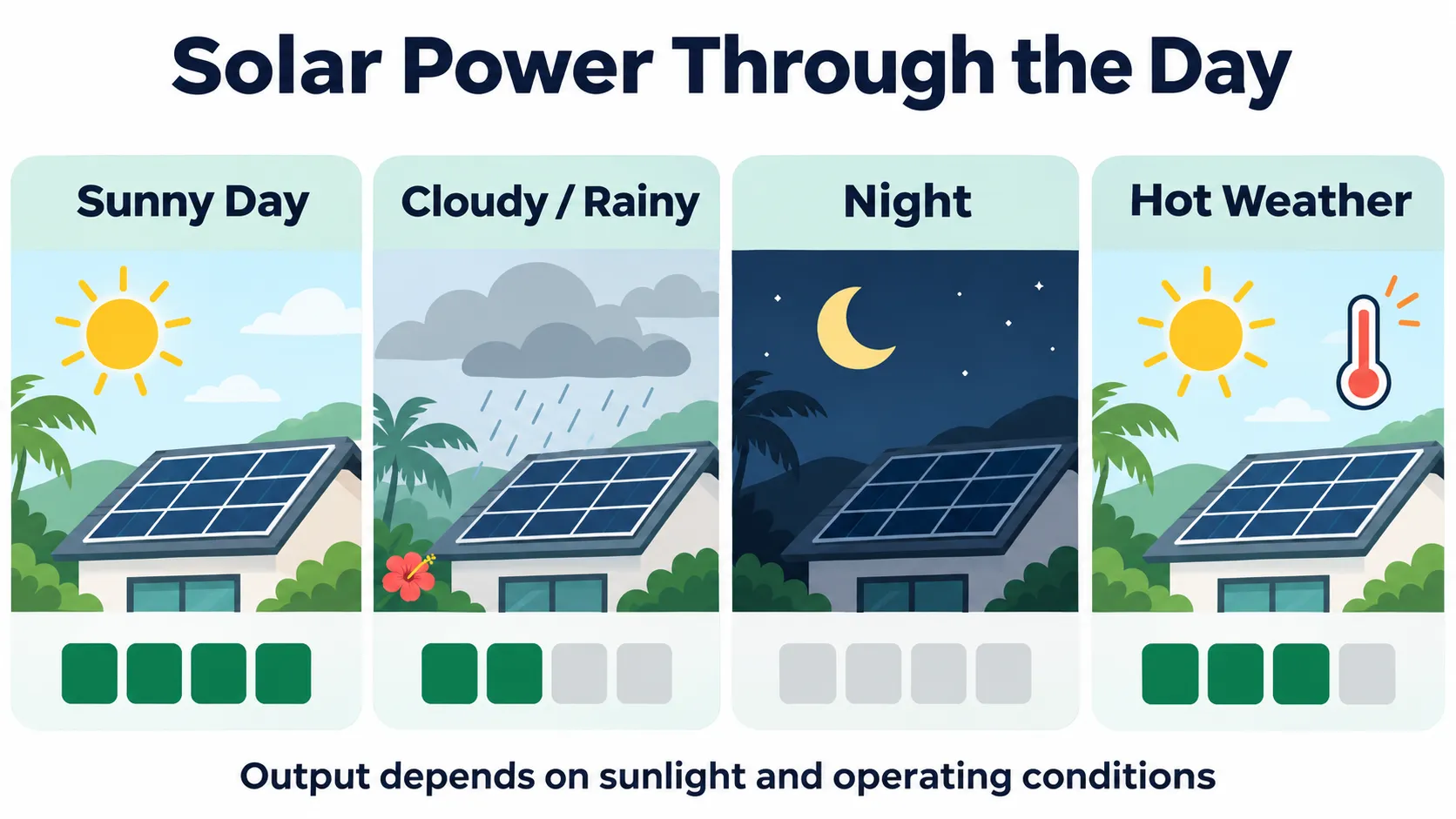
Malaysia supports year-round solar generation, but output varies with sunlight, heat, shading and weather.
Solar panels do not generate electricity at a constant rate.
On Sunny Days
Strong sunlight generally produces higher output than heavy cloud or shade.
Generation typically rises in the morning and falls towards evening.
On Cloudy or Rainy Days
Solar panels can generate electricity on cloudy days because some sunlight still passes through clouds.
However, cloud cover reduces the amount of solar radiation reaching the cells, generally lowering electricity production.
“According to METMalaysia, the Northeast Monsoon generally occurs from November to March, bringing particularly heavy rainfall to the east coast of Peninsular Malaysia, western Sarawak and eastern Sabah.”
Solar panels can still generate electricity during cloudy periods, but extended heavy cloud cover may reduce daily output.
The grid can continue supplying electricity to meet demand when solar production falls, provided the grid supply remains available.
During Hot Weather
More heat does not necessarily mean more electricity.
Solar cells become less electrically efficient as their operating temperature rises.
Strong sunlight and high temperatures affect output differently.
Rooftop panels can become hotter than the surrounding air, affecting output.
At Night
At night, a standard grid-connected property normally relies on electricity from the grid.
If the installation includes a suitable battery system, previously stored electricity may be available for use.
However, battery storage is a separate function. Solar panels themselves do not store electricity.
Do Solar Panels Work During a Power Outage?
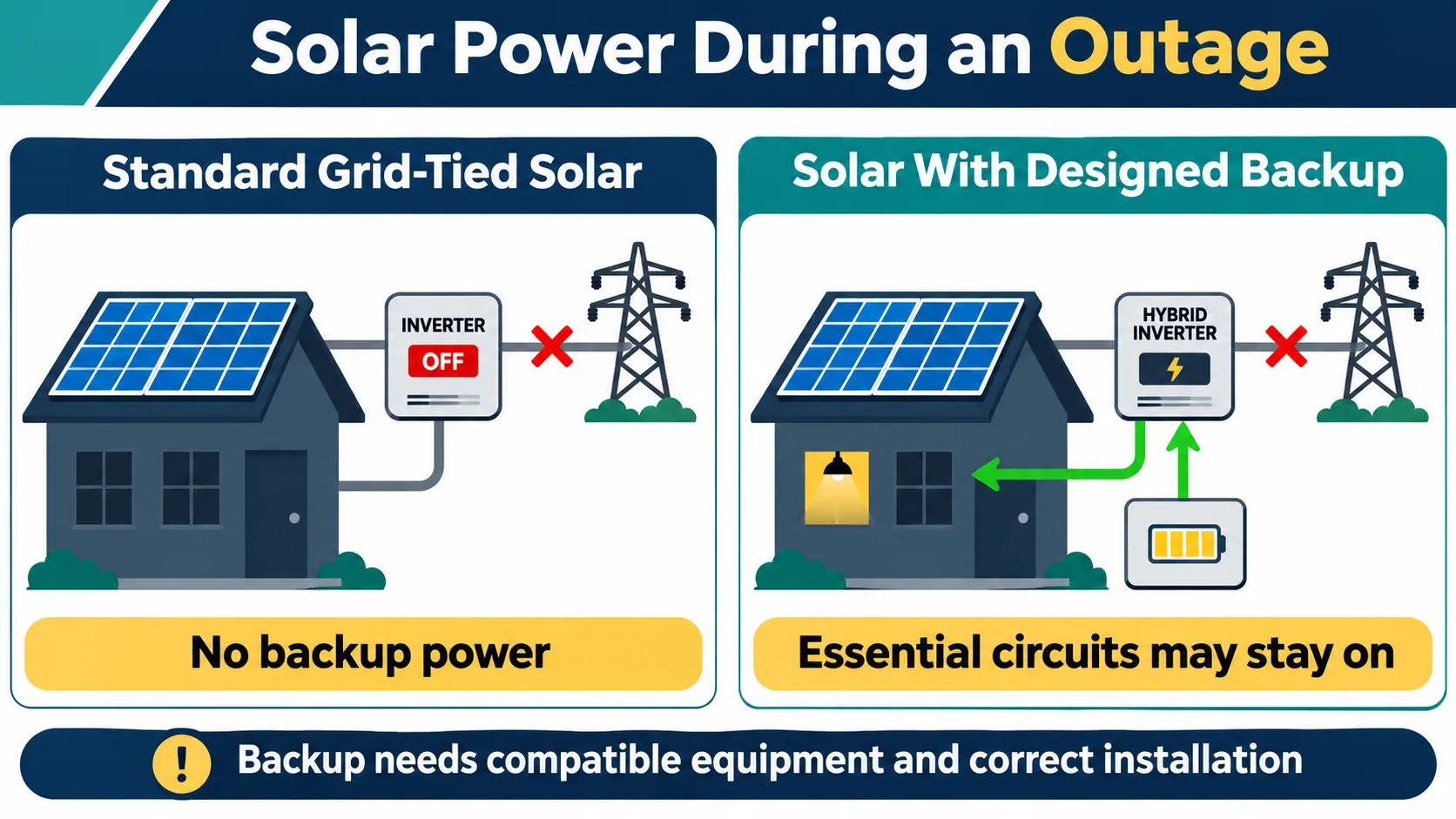
Rooftop solar does not automatically provide electricity during a blackout.
In most standard grid-connected systems, solar generation stops supplying power when the electricity grid fails.
Grid-connected inverters detect the outage and disconnect for safety.
This prevents unintended power flow into a disconnected network, protecting workers and equipment. This protection is commonly associated with anti-islanding.
A properly designed solar-plus-storage system may provide backup, but not every battery-equipped system supports it.
Can Solar Panels Store Electricity for Nighttime Use?
Solar PV panels generate electricity but do not store it.
Electricity storage requires additional technology, such as a battery energy storage system (BESS).
Batteries can store electricity for later use, subject to system design.
For commercial and industrial facilities, energy storage may support:
- Using stored electricity during periods of lower solar production.
- Managing fluctuations in electricity demand.
- Supporting selected critical operations where backup capability is specifically designed.
- Coordinating solar generation and energy consumption through an energy management system.
However, adding batteries does not automatically make a property independent of the grid.
Backup performance depends on stored energy, output capacity and connected loads.
For businesses considering energy storage alongside rooftop solar, EFS Group provides battery energy storage systems designed around operational and electrical requirements.
How Does Solar Electricity Work for Malaysian Factories and Businesses?
Solar PV works on the same principle in homes and factories.
The differences lie in electrical demand, scale and operating hours. Daytime factories may use solar electricity for machinery, ventilation and lighting, which of course consumes more power.
Consider a factory with the following hypothetical operating conditions:
Operating Condition | Electricity Flow |
Sunny morning | Solar generation contributes to factory demand |
Midday production | Solar and grid electricity jointly supply machinery |
Afternoon rain | Solar output falls and grid imports increase |
Night shift | Grid electricity supplies demand unless suitable storage is available |
Actual electricity flows depend on the factory’s demand and installed system configuration.
Industrial projects must also consider electrical protection and existing infrastructure. Hence for factory owners who are interested, EFS Group offers industrial solar systems designed around the specific requirements of manufacturing and industrial facilities.
How Can You Tell Whether Your Solar Panels Are Working?
Solar generation cannot be judged simply by looking at panels. Inverter displays and monitoring platforms help owners track system performance.
Common measurements include:
- Current power output (kW): The rate at which the system generates electricity.
- Daily energy generation (kWh): The total electricity produced during the day.
- Historical production: Electricity generated over previous days or months.
- System alerts: Notifications about faults or abnormal operating conditions.
How to Calculate Solar Electricity Generation
You can estimate electricity generation using this simple formula:
Energy Generated (kWh) = Power Output (kW) × Operating Hours
For example, suppose a solar system maintains an average output of 3 kW over four hours.
Measurement | Example |
Average power output | 3 kW |
Generation period | 4 hours |
Calculation | 3 kW × 4 hours |
Total electricity generated | 12 kWh |
This means the system produces 12 units of electricity during that period, as 1 kWh equals one electricity unit.
However, solar output fluctuates throughout the day and for a more accurate assessment, compare daily kWh readings from your inverter or monitoring platform across similar weather conditions.
Again, we have a whole article explaining how to calculate solar panel needs, so go check it out if you’re interested!
Conclusion: Understanding How Solar Panels Work in Malaysia
For Malaysian homes and businesses, solar generation works alongside electricity demand and grid supply.
Understanding how solar panels operate, including their performance during cloudy weather and power outages, helps property owners make informed decisions.
With over a decade of renewable energy experience and more than 300 MWp of solar capacity delivered, EFS Group provides comprehensive solar solutions for Malaysian homes, businesses and industrial facilities.
Here’s why customers choose EFS Group:
- Over 10 Years of Industry Experience: More than a decade of experience supporting residential, commercial and industrial solar PV projects.
- 300+ MWp of Reported Solar Capacity Delivered: Delivering over 300 MWp of solar capacity across Malaysia and the region.
- End-to-End EPCC Services: Integrated engineering, procurement, construction and commissioning under one experienced team.
- Customised Solar PV Solutions: Systems designed around your property’s electricity consumption, roof conditions and operational requirements.
- Solar and BESS Expertise: Integrated solutions combining solar generation with battery energy storage where appropriate.
Ready to make better use of Malaysia’s solar energy potential?
Contact EFS Group today to discuss your solar energy requirements and take the next step towards cleaner, more efficient electricity generation.
Sources:
- SEDA Malaysia – Malaysia Renewable Energy Roadmap (MyRER), 2021
Supports: Malaysia’s historical solar irradiation average of 1,726 kWh/m² annually. - Tenaga Nasional Berhad (TNB) – Electricity System
Supports: Malaysia’s nominal electricity supply specifications of 230 V (single-phase), 400 V (three-phase) and 50 Hz. - Suruhanjaya Tenaga (Energy Commission) – Guidelines for the Approval of Electrical Equipment, 2024 Edition
Supports: Malaysian electrical voltage and frequency standards. - Malaysian Meteorological Department (METMalaysia) – Weather Phenomena
Supports: Northeast Monsoon timing, seasonal rainfall and affected regions in Malaysia. - U.S. Department of Energy – How Does Solar Energy Work?, 2020
Supports: Photovoltaic effect and conversion of sunlight into electricity.